Sunday, 1 April 2012

There Are No Mountains In Norfolk

"If you think Norfolk is flat - get a bike!"
That was once the advice given to tourists visiting our beautiful county for the first time.

It is true, there are no mountains in Norfolk but we do have our own "Little Switzerland".
"Little Switzerland" are old chalk excavations near Coltishall that were abandoned many years ago.
The entrance to the chalk workings  at "Little Switzerland" were entered from the river Bure near Belaugh.  A series of channels were carved out  over several generations as great volumes of chalk were extracted from the  site.

Evening at Belaugh
Because the channels were only suitable for wherries of very shallow draught smaller lighters were built to ferry the chalk to the "Traders" waiting at the mouth of the excavations.

Chalk or marl was used mainly for improving agricultural land, it was also an important component in the production of bricks.  Marl was used primarily on the land to reduce acidity and improve the texture of the soil.  Wherries were able to provide a constant supply of  this valuable resource to local farms.  Marl mixed with farmyard manure improved the fertility of the land so much that farmers and land owners on the upper Bure claimed  "The carrots had doubled in size and the land had doubled in value".
On the Aylsham Navigation and the North Walsham and Dilham Canal chalk or marl was toll free which guaranteed work for the wherrymen supplying the lime kilns and farms along these waterways.

There are an abundance of chalk deposits close to the river Bure around Coltishall and Horstead.  Wherries would load the marl until the water lapped onto the plank ways, then loaded to the bins, the the great black sail would carry the marl through the network of rivers and broads sometimes up to fifty miles away.

Around 1810, a cart load of marl cost one shilling but it cost another three shillings and sixpence to transport it along the notorious Norfolk lanes and cart tracks.  It is no surprise to learn that marl became one of the most common cargoes carried by wherry.  The cavernous hold of the "traders" provided farmers with an economy of scale that horse drawn transport simply could not.
A Bridge at "Little Switzerland
Today the steep banks of "Little Switzerland" bear the scars from whence the chalk was extracted.  Willows and Elders have colonised the slopes and whole area has become a haven for wildlife.   The chalk workings were abandoned around 1870, a date that coincides with an expanding railway network.  Until then "Little Switzerland" would have been at the centre of a thriving industry employing many local men.   Some would have travelled across the river in small boats from Coltishall and Belaugh, others would have trudged along Granny Bard's Lane through the morning mist.  Probably carrying a bottle of cold tea and doorsteps of bread and cheese with an onion for added flavour.
Before the days of mechanisation the chalk would have been dug out with picks and shovels working along  terraced levels.  It would have been thirsty work in Summer and heavy work in Winter.
One Of  The Dried Out Channels


We recently attempted to canoe along the old chalk workings.  We left the Bure at Belaugh but it was only possible to travel a few yards along the channels which have dried out and become overgrown.  Our canoe soon came to grinding halt and any hope of retracing the route of the wherries was very quickly ruled out.
"Little Switzerland's" Concealed Entrance
I have been told that there was once a small tavern on the site where the labourers and wherrymen would congregate after work.  If this is true there is no evidence to suggest where the tavern was located, but we did see several old, broken bottles on the bank close to the entrance.

 The old chalk workings at "Little Switzerland" are private property and not open to the public.  However it is possible to see parts of the old channels and a bridge from a public right of way that runs alongside the estate.  I took a camera along there a few weeks ago to take a look.   The brambles put up a very determined defence and  in spite of several life threatening scratches I did manage to get a few  photographs.
Private Property Notification
The area is a great example of industrial archaeology and a glimpse into the past. If only those channels could be opened up and re-watered they would provide a magical boat trip through an enchanted forest.  But I guess that is never going to happen.

Authors Footnote.
There is very little information available relating to the chalk workings at "Little Switzerland".  Any additional information would be most welcome in order to satisfy my curiosity.

Jonno.


Wednesday, 7 March 2012

Vanishing Species

I started filming local crafts and traditions to capture them before they disappeared completely.
I hardly expected the losses to take effect quite so soon, before I had finished the film in fact.
On Saturday evening I dined with the eel-catcher who appears in the film.   During the course of the evening  the conversation inevitably turned to eels.  It seems that eel numbers have declined so much over recent years that they are in danger of becoming extinct.  I guess the majority of anglers will welcome this news.

Eels found in the East Anglian rivers (Anguilla anguilla) breed out in the Sargasso Sea, in an area between Bermuda and Puerto Rico.  The tiny eels are carried by the Gulf Stream until they reach the coasts of  Europe as two or three year old elvers.   They will spend the next twelve years living and growing in our rivers until they are mature enough to return to the Sargasso sea to breed.
The mature silver eels move down river on their way to the distant spawning grounds in late summer and autumn, mainly at night.
 Anguilla Anguilla
Two factors have conspired to threaten the species.  The first is a virus that effects the swim bladder of the eels.  The second is the export of the small elvers which are considered a delicacy and command a high price.   Both these factors result in fewer eels reaching maturity to return to the Sargasso to breed.  It is quite probable that children three generations on will never see a live eel and it is a racing certainty they will never see a live eel catcher.

During the early part of the nineteenth century there was an abundance of eels in the East Anglian waterways.  Some eel catchers made a living by trapping this remarkable fish while the marshman was probably satisfied with taking an eel or two for his family needs with an eel pick.
The Eel pick was a long handled tool with springy tines.   This method was used in shallow inland waters and salt water estuaries.  The eel catcher would look for bubbles from the eel’s fore and aft blow holes.  He would then strike with the pick, if done correctly the tool would be removed with an eel trapped between the tines.   Herons use their bills in the same way.

 Eel Pick
At the end of the nineteenth century catches were recorded by the stone.  In 1914 one eel catcher landed 129 stone of eels in a season.  
The biggest eel ever caught was in 1738 – it weighed sixty two pounds and measured twenty six inches around its girth.   

Ely in Cambridgeshire was once known as the Isle of Eels before steam power was used to drain the surrounding fens.  Such was the value of eels in the 11th century, that they were accepted as payment for taxes to the crown.

One hundred years ago many eel catchers lived aboard small boats out on the broads and estuaries; they used nets and traps to catch saleable volumes of eel.
Eel traps or hives, were made from willow with a conical funnel at the base and  a bung at the neck.  The funnel allowed the eel to squeeze into the trap but once inside it could not get out.  
Willow Eel Hive

The same principal is applied to fyke nets.   
The fyke net is a long net supported by metal hoops with three funnels or purses at the end, a long runner guides the eels into the purse and traps them in the same way as the old willow traps. 

My Eel-catcher friend assured me that eel numbers have declined by some eighty five per cent in the last few years - no species can survive those kind of losses.  Catches of eels are down year on year to a point when it is no longer viable to catch them for profit.
Long gone are the days when boxes of eels covered in wet sacks would be sent by rail to London to provide the capital with their diet of  "jellied eels"   Unless some form of conservation is rapidly deployed we will lose these remarkable creatures.  


Sadly it seems my trips out with the eel catcher on those long summer evenings are already a thing of the past.

Saturday, 11 February 2012

The Flood Of 1912.

One hundred years ago  forecasting the weather relied,  for the most part, on reading cloud formations  and watching the behaviour of wild creatures.  This method was not an exact science and the weather could, and did, spring some nasty surprises. This happened on August 26th 1912 when it rained for three days and three nights.  Rain of biblical proportions fell over Norfolk - in those three days bridges on the Aylsham Navigation were washed away and locks were destroyed by torrents of flood water.    In just a few hours the days of the wherries on the Upper Bure were gone forever, and with them one hundred and thirty years of  custom and tradition.

Oxnead Lock

It is ironic that in this centenary year of the great flood we are already facing water restrictions because of drought conditions persisting in East Anglia.   Knowing how "Mother Nature" has a way of balancing things when it is needed  - are we going to experience an extra wet spring or summer?
Could history be about  to repeat itself?

For the last ten months I have been working on a film for the Bure Navigation Conservation Trust.  The newly formed trust are commemorating the great flood of  1912 on August 26th this year.   It was only when I began to research the film that I discovered an absolute treasure trove of  local history.   Along this nine and a half miles of picturesque waterway between Horstead and Aylsham, are five historic watermills and a pair Tudor manor houses.

Burgh Mill

There are four churches on the  banks of the river - one of them, St Theobald, a sad old ruin that stands abandoned in an atmosphere of gloom and melancholy.  
Between Buxton and Oxnead the waterway flows silently past the forgotten resting places of Anna Sewell - author of "Black Beauty",  Walter Rye and Sir Clement Paston.

Sir Clement Paston

Running alongside parts of the navigation are the remains of the old M&GN railway line. A cast iron bridge, built in 1879, straddles the river at Buxton.   The line is now operated by the Bure Valley Railway.

Not only does the Upper Bure have a long and distinguished history,  it is thriving in these modern times.  Deer roam through it's woodland and Cattle graze in it's pastures.  Pike lie in deadly silence among it's reeds and Trout spawn in it's gravel shallows.  The Bure Navigation Trust is dedicated to protecting the river and making it more accessible to the public.  The old navigation is a unique place of  peace and tranquillity  - a legacy of the flood of 1912.


For more information about the Aylsham navigation and centenary events visit their website.  
http://aylsham-navigation.norfolkparishes.gov.uk/


Sunday, 22 January 2012

Review Of 2011.

Even though it has been a very mild winter the grey overcast skies and shorter daylight hours have curtailed my filming expeditions much more than I would have liked.   But every cloud has a silver lining and winter is a great time to edit and catalogue the film that has been shot throughout the previous twelve months.
Reviewing the material is like fast rewinding the year - remembering the places I have been and the people I have met during this years filming.   Here is a selection from 2011.    Enjoy!   


                       Vintage ploughing and farm machinery - a shot from "The Marsh"


                                                   Gentle Giants at the same event.


                             Oxnead mill pool from  "Aylsham Navigation" 

 
                                How Hill at sunset from  "My Norfolk Year"


                                Shooting a sequence for  "The Station"


 Hunstanton, the only place in Norfolk where the sun sets on the sea.  Not in any film - I just liked the shot.


Anna Sewell's birth place in Gt Yarmouth and the house in Norwich where she died shortly after writing  "Black Beauty".     Anna Sewell is remembered in "Aylsham Navigation"


Hunstanton church where a  customs officer and a dragoon are buried, killed by smugglers.
 Featured in  "The Marsh"


Between shots of  Reed cutters on the Waveney,  from "The Marsh".


Tuesday, 6 December 2011

Black Shuck - The Hound From Hell.


"Black Shuck" -  "The Hound From Hell" is a well known East Anglian legend - a large black dog with eyes that burn like red fireballs.  He roams the coastline and the marshes right across Norfolk and Suffolk.   Anyone who looks into those flaming red eyes will be dead within twelve months, according to the legend.  

 In September 2011 we loaded the cameras and headed for Suffolk to follow in "Shuck's" paw prints.  

"Shuck's" first recorded appearance was in Bungay, Suffolk, on August 4th 1577.  During a violent thunder storm a large black dog ran into St Mary's church and attacked and killed two of the congregation.  A third man survived, it was said his wounds resembled scorched leather rather than wounds consistent with an animal attack.
It was also claimed that the dog's claws left scorch marks on the church doors of the North porch.   Unfortunately any evidence to support this was lost when the church was badly damaged by fire in 1688. 

A few miles away in Blythburgh a similar attack took place during a violent thunder storm.  Again it was reported that a large black dog ran into the church and attacked members of the congregation, a man and a boy were killed.  During the attack the steeple was struck by lightening and part of the masonry crashed through the roof of the nave.  Once again Shuck's claws left scorch marks on the church doors, these marks are still clearly visible. 

Earlier the same day a local man was chased by a large black dog,  this fellow was able to reach the safety of the parish church before the dog could attack him.  Again scorches and scratch marks were left on the doors of the church.  

Although phantom Black Dogs have been reported since Roman times the events in Suffolk in 1577 gave a perceived credibility to "Black Shuck's" existence.   The "Hound from Hell" tag originated from the belief that Shuck was actually the devil who appeared in the form  of a black dog.  If the story had ended there the legend might have been relegated to the status of an "Old Wives Tale" but over the last four centuries there have been many sightings of the black dog.  From Suffolk to North Norfolk people have claimed to have seen the dog with flaming red eyes.

In 1890, on Yarmouth beach, a young lad was preparing to swim in the sea when a large black dog approached him.   The boy entered the water and began to swim - the dog followed.  For some time the two of them swam together much to the amusement of the teenager.  The young lad was enjoying the swim with his new friend but as he was beginning to tire he decided to to turn back to the beach.  The black dog snarled and barred the way, several bites to the boys feet and back forced him further out to sea.   He was practically exhausted when a fishing boat spotted them.  Assuming the boy and his dog were in trouble the fisherman rowed over to assist them.   They hauled the semi conscious youth into the fishing smack and were horrified to see deep wounds in his back, shoulder and feet.  As they made for the shore they watched the black dog swim out to sea until it was out of sight.

A stormy night in North Norfolk in 1980 a holiday maker stopped to buy a pint of milk at a village store.   He left his young son in the car while he nipped into the shop.  A few minutes later he emerged with the milk just in time to see a large black dog disappear into a copse on the opposite side of the road.
Inside the car the child sat frozen with fear - he told his father the dog had glowing red eyes and had tried to get into the car.  The following day the father found large muddy paw prints on the bonnet and the back window of the car. 

Between West Runton and Overstrand there have been so many sightings over the years the area is called Shuck's Lane.  Sir Arthur Conan Doyle who was convalescing in Cromer would often dine at Cromer Hall with the lord of the manor.  He heard many stories about the black dog from Baskerville the lord's coachman.   Soon after his stay in Norfolk Sir Arthur wrote "Hound of the Baskervilles",  without doubt Shuck was the inspiration. 

I am ecstatically happy to report that we saw no trace of the "Hound From Hell"  so we have had to recruit a large black dog to appear in the film on "Shuck's" behalf.   To say Shuck does not exist would be the logical reaction for most people.   But next time you find yourself walking along a lonely Norfolk lane in the fading light, you might have to ask yourself, is it the North wind howling or could it be............


Authors Footnote 8th February 2012.
Sightings of a black Puma or Panther loose on the outskirts of Norwich yesterday.   This is the latest in a series of sightings of what is definitely a large black animal roaming the Norfolk countryside.
These sightings have been reported regularly over the years but so far no evidence has ever been found.  One would expect to find evidence of kills or paw prints if there was a big cat on the loose but so far nothing.     What if.............?


Saturday, 29 October 2011

A Film Odyssey.

When I am not lugging camera equipment around the more remote parts of Norfolk and Suffolk I often ask myself why on earth am I spending so much of my time shooting a film which only a handful of people will  see.  Then, in my quieter moments I try to figure out  what drove me to start out on this film odyssey in the first place.

Somewhere in the sunlit uplands of my memory I recall my early years in a little village in west Norfolk.
One night in April 1942 the Luftwaffe destroyed our family home in Norwich just a few weeks before I was born.

                                      courtesy of wikimedia creative commons licence.

We were evacuated to the sanctuary of the rolling farmland of west Norfolk where a kindly old couple took us in.  The old couple became my adopted "Nanny and Grandpa Rawlings"  My newly acquired  grandparents were good old Norfolk stock.  "Grandpa" was a big man and as strong as an ox but had a gentle demeanor .  "Nanny" was a slightly built woman with an air of understated independence.  They did not have very much but were contented and quite happy to share what little they had.

I guess we didn't take up too much room as most of my parents possessions had been destroyed along with the greater part of the house.  This was just as well as the new home we shared with the Rawlings was a tiny terraced cottage with just two small bedrooms.   The front door of the cottage stepped down off the main street onto the stone floor of the parlour.  The parlour was small but uncluttered apart for a modest collection of  Edwardian china ornaments.  An enormous oil lamp occupied pride of place on a plain, unvarnished, wooden table.  Two wooden chairs with crocheted cushions faced an open fireplace.  On one side of the fireplace a huge soot encrusted  kettle was in perpetual steam.
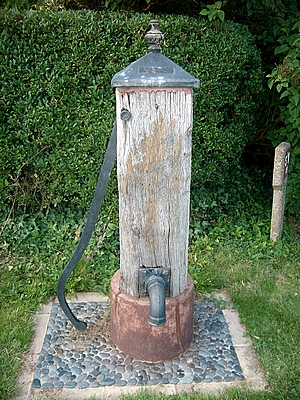
The tiny scullery had stone floors with a coal or wood fired boiler in the corner.  Water was pumped into the cottage by means of a hand operated pump mounted beside a shallow stone sink.  This was quite a convenience compared to many families who had to carry buckets to and from the village pump.

                                           courtesy of wikimedia creative commons licence.

Behind the cottage was a long vegetable garden with row upon row of green produce.  At the end of the garden, surrounded by stinging nettles, was the thunder box  (WC).
Stone floors, Oil lamps, a wall oven and chamber pots were more than enough for all our daily needs.

Eventually Dad was able to rent a small cottage behind the village bakery and for the next few years we were awakened to the smell of fresh bread every morning. 

Some time after the war had ended we moved back to Norwich. The old house had been repaired with different coloured bricks to the originals.  Red rustics at the front and cheap War Damage "Flettons" at the back.  But we did have the luxury of running water at the turn of a tap, electric lights and flush a toilet, even if it was outside.
In our oddly coloured house I spent the remainder of my childhood.   Along with the other urchins from the neighbourhood I proudly shared ownership of the "bombed site" at the bottom of our garden.  The remains of the "bombed out" cottages provided an endless source of material to build dens and light fires.  

The two environments could not have been more different and as the old saying goes - "You can take the boy out of the country but you can't take the country out of the boy." 

In subsequent years we made regular visits to see "Nanny Rawlings" in the little cottage we had once called home.   We did not have a motor car so we travelled by steam train on the old M&GN line.


Passing  horse- drawn sail binders in the harvest fields and row upon row of wheat sheaves lining the golden stubble in perfect symmetry.
Standing guard over freshly sown acres were sad, lonely old scarecrows dressed in farm labourers "cast offs" and condemned to a  life of solitude.
Heavily laden trees lined the orchards while herds of cattle and flocks of sheep grazed contentedly in the meadows.  An endless stream of these rustic images drifted past the carriage window shrouded in wispy steam.   It was like travelling back in time but those images became indelibly etched in my memory.

                                        courtesy of wikipedia creative commons licence.

Sadly progress is a fearsome animal with a voracious appetite, it devours the years without regret or conscience.  Then one day we realise that the people and things we once knew and loved are gone, and sadly, we hardly notice their passing.  I suspect this is the reason  I embarked on this film odyssey.


To watch "My Norfolk Year" video.
http://www.youtube.com/watch?v=4y_Ova5fHNE&feature=plcp

Saturday, 8 October 2011

Smugglers

Skippers of wherries could earn more from carrying one or two tubs of  smuggled French brandy than they could from hauling forty tons of coal.   In the early part of the nineteenth century smuggling was rife, even severe punishments did not deter wherrymen from carrying "Little extras".   Imprisonment at best or transportation at worst.  In the early 1800's transported prisoners were sent to the swamps of Africa which was practically a death sentence,  transportation to Australia came many years later.  Once contraband was seized the wherry would be burned even before the felons had been sentenced.
For the wherrymen moving contraband along the waterways was much needed income but they were only on the fringe of the "Free Trade" industry.
Romantic notions have become attached to 19th century smugglers which is far from the reality of the period.
Smuggling barons were ruthless violent men who became rich from their criminal activities and they would not hesitate to deal with anyone who stood in their way.

We took the cameras to West Norfolk to record a dramatic event that took place in September 1784.

Smugglers were waiting off shore for the all clear signal from the cliffs at Old Hunstanton, they did not know that customs officers and a troop of Dragoons were waiting for them in the darkness.  As the contraband was being brought ashore the Dragoons charged across the sands at full gallop with sabres drawn.  The smugglers, upwards of fifty men, scattered in all directions.
The smuggler's carts and ponies that had been abandoned on the beach were commandeered by the excise men and the smuggled goods were taken to nearby "Clares farm" which is now part of the Caley Hall hotel.

Reinforcements of Dragoons arrived at Old Hunstanton and were sent to the beach in case another attempt was made to land more goods.
The gang leader of the smugglers was enraged when some of the landing party returned to the lugger and  gave him the news of the customs seizure.   Without hesitation he armed the remainder of his crew with pistols, muskets and sabres, the long-boat was launched and the smugglers set off to recover the contraband that had been seized.

As the smugglers made their way from the dunes they spotted the advancing column of dragoons and concealed themselves in a ditch.  The column passed at close range, the smugglers opened fire, private William Webb at the head of the column was hit four times and fell from his horse.
A second volley fatally wounded customs officer William Green who died hours later at Clare's farmhouse.
By the time the Dragoons had regrouped the smugglers had fled.  The gang leader, William Kemball, was later apprehended along with most of the gang.  He was held in Norwich prison until the Thetford assizes seven months after his arrest.  Ironically the wealth accumulated from smuggling activities afforded him first class legal representation which allowed him to escape the death penalty and resume his smuggling career.


This sad little story is not uncommon in Norfolk.  There are three customs officers buried in St Nicholas' churchyard, Great Yarmouth.   Seven other revenue officers were wounded in the same action that was fought off the Yarmouth coast.   There is another officer buried in Bacton churchyard.  All of them killed them by smugglers.


We ended the shoot at the little village church where we filmed the graves of the Dragoon, private Webb and the Customs officer William Green.  
As we stood at the graveside it was not difficult to imagine young Phoebe Green standing there all those years ago, a widow at twenty three.