Showing posts with label horse-drawn. Show all posts

Friday, 5 December 2014

A Busy Ol' Summer.


With frosty mornings and icy winds to look forward to this seems a good time to look back over the last six months.  As far as summer's go this year has been one to remember.
It seemed to stretch endlessly into infinity,  reminiscent of my school holidays from long ago, when those precious school-free weeks ran out long before those wonderful summer days.

If I ever had a busier summer with a camera than this one I really don't remember it, and with seven projects in progress the cameras have been in constant use almost every day since early spring.  But if there is a better way to spend my time I can't imagine what it is.

Hathor's Restoration.
One of my regular weekly visits is the Wherry Yacht Charter Charitable Trust's yard at Wroxham.  Here the pleasure wherry "Hathor" has been under-going major restoration.

"Hathor" was winched onto the slipway over twelve months ago.
On February 19th, with her hull fully restored, she was re-floated and work began immediately on her topside and interior. First stage was to repair the plankways and cabin sides.  Then her decks were lined with plywood and covered with hard wearing lino.  Work has recently begun refurbishing the cabins and saloon.

Each stage of "Hathor's" restoration has, and is being recorded.  As the summer finally faded away this grand old lady was beginning to look her best once again.
Lining "Hathors" foredeck with plywood.

Fitting the Hawk benches.
"Sam" enthusiastically watches proceedings..

The  North Walsham and Dilham Canal.
On the North Walsham and Dilham Canal the restoration continues apace.  The banks of the dry section between Spa Common and Royston Bridge are well on the way to being reconstructed.  This is due to the extended dry spell from June to August which allowed a fleet of tipper trucks  to haul in tons of high grade subsoil.  Day after day they emerged through the dust creating some wonderful shots for the camera.  On the North side of Royston Bridge the progress has been equally impressive as the reconstruction heads unerringly toward Swafield.

Tippers bring in high grade subsoil.
Trucks emerge through the dust
A section of restored banking.
In late summer, with the help of a friend using his "Phantom" drone, with a GoPro camera on board, we were able to shoot some stunning arial footage of the reconstructed banks.

A magnificent distraction on the canal was the brood of Swans that hatched near Spa Common.   They have been high on the filming agenda on my regular, weekly visits to the canal. We have a record of the day they hatched to the present when they are now almost full grown.
They were the subject of an earlier blog.  If you would like to see the brood click on the links below.

http://bigskyproductions-jonno.blogspot.co.uk/
https://www.youtube.com/watch?v=SczVJ2UJf1Y


On September 26th as the summer was drawing to a close,  Doug Hamilton Cox, a retired Royal Engineer, walked the canal from Swafield to Tonnage Bridge.  We filmed the event which is intended to raise funds for the "Help For Heroes" charity.  Doug plans to walk every canal in the UK and raise £100,000.00. 
"Help for Heroes" Canal walk at Swafield lock.


Mist On The Marsh.
My labour of love continues to move toward completion, albeit very slowly.  All the documentary sequences are complete and most of the dramatised folklore is safely " in the can".   My undying appreciation for the cast, who with unswerving loyalty, have stuck with me and the project through some very trying times.  An extra special effort to complete this epic is scheduled for early 2015.
A clip from "Mist On The Marsh".


M&GN Dray.
While all this was going on, the M&GN  horse drawn dray was undergoing overhaul which I filmed whenever possible.  The film started at Banningham, where the hundred year old cart was renovated.
Dray off to Weyborne works.
This included the metal tyres being heated and fitted to the wheels.  From there the dray was taken to the sheds at Weybourne where the overhaul was completed.  Finally the dray was filmed arriving  at Holt station drawn by a magnificent shire horse.
Dray in the carpenters workshop.

Fitting the metal tyres.
The Dray arriving at Holt station.


Slipping "Albion"
On October 9th, in the dying weeks of our wonderful Indian summer "Albion" was being hauled out at Oulton Broad.  We arrived at Excelsior's yard to record the wherry being winched onto the slipway.
A brisk south-westerly rippled across Lake Lothing as "Albion" was secured to the cradle and hauled out of the water.
"Albion" almost out of the water.

Secured in the cradle.

On November 24th "Albion" was re-floated after her routine maintenance was completed.  Once again we made our way to Oulton Broad in time for "High water".  The wherry was smoothly lowered down the tracks and into the water.  With the tender standing by, the bilges were checked for leaks before we set off for the lock.  The traffic was stopped as "Albion"  slipped under the road bridge and into Mutford lock.  The summer was finally behind us on this shoot, but even at this late date the sun followed us into the yacht station to round the year off nicely.
The skipper checking tide times.
The tender standing by.

Stopping the traffic.

Inside Mutford Lock.

I hope the above demonstrates why the blogs have been few and far between in recent weeks.  We will try harder in 2015.
Merry Christmas  and a Happy New Year!

Jonno.

Sunday, 1 July 2012

The North Walsham and Dilham Canal. Part One.


Eighteen months ago I knew very little about the North Walsham and Dilham canal.  It was merely by chance that I stumbled on the EAWA website and saw a notice asking the volunteers to meet at Briggate mill for one of their fortnightly work parties   I thought it would be a good idea take a camera along and see what was going on.  I expected to see a handful of people in wellington boots armed with shovels and forks.   What I did not expect to see were two excavators and a hydraulic tipping dumper, all of them on caterpillar tracks.  By the time I arrived, at about ten o'clock, every machine and volunteer was industriously beavering away.    The task for the day was to continue excavating the old Briggate mill pool, work which had been started many months before.   The chain saws whined as they cut through the fallen trees that blocked the channel where wherries had once moored.  The excavators removed the tree stumps and widened the channel. This was surgery of a serious kind.  It has to be said the area was very boggy and cut up quite badly,  it was this unedifying spectacle that had alarmed some local people.  Now twelve months on the scars have healed and the area is a picture of peace and tranquillity - a beautiful spot to just sit and relax.  The whole place is alive with wildlife, the star turn are undoubtedly the pair of Egrets who fish there regularly. 

                                                             Snowy Egret
                    ( Photograph courtesy of Mike Baird - creative commons licence.)


Click the link below if you would like to see a video of the Egret fishing.
http://www.youtube.com/watch?v=3rrANidG0hQ&feature=plcp

Before 1810 the river Ant was only navigable as far as Dilham but on May 5th 1812 an act of parliament allowed the river to be canalised.   However work did not begin until 1825 and the canal was not formally opened until 29th August 1826.   The waterway was nine miles long from Dilham to Swaffield boasting six locks which raised the water level by some fifty eight feet.  Each lock was designed to allow wherries to pass through them providing their maximum dimensions did not exceed fifty feet in length, twelve feet six inches in  beam and a draught of no more than three feet when laden.      The water source for the canal came from the Antingham ponds but there was never quite enough and there was constant friction between the Mill owners and wherrymen who both felt their need of the available water was the greater..

Freight on the canal included  flour, grain and bone-meal being transported from the mills along the canal to the port of Great Yarmouth. Building materials, manure and marl were brought in the opposite direction.  Coal never became the lucrative cargo that the share-holders of the canal had hoped it would be.   Colliers continued to unload coal on the beaches at Happisburgh and Cromer and from there it was brought overland by horse drawn waggons denying the canal significant income.

Tolls for all freight carried on the North Walsham and Dilham were collected at Tonnage bridge.  The bridge  collapsed in 1980 but was replaced true to its original design in 1982 with the help of a grant from the Broads authority.


Attempts were made to improve trade on the canal with the introduction of pleasure boating.
Edward Press a miller at Bacton Wood, (who later bought the canal),  owned  five wherries he converted some of them  to pleasure wherries and operated them out of his yard at Ebridge.
Ebridge Today
It was the East Norfolk Railway that signalled the beginning of the decline in the canal's fortunes when the line from Norwich to North Walsham was opened in 1874.   As a direct result of  diminishing returns the section of canal from Swafield lock to Antingham was abandoned in 1893.  Buried in Swafield church  is the grave of  Jack Gedge skipper of the "Gleaner". His headstone is inscribed "the last wherryman", he died in 1989 aged one hundred, a gentle reminder of the halcyon days on the canal.

Jack Gedges Headstone at Swafield
 The canal has changed hands many times, one of the most notable was the purchase by Edward Press who paid £600 for the canal in 1886.  A lawyer named James Turner was appointed to pay off the shareholders but he decided to keep the money for himself and absconded with the funds.
 
The North Walsham and Dilham escaped the great flood of August 1912 with relatively little damage , unlike the Aylsham navigation which was totally wiped out as a navigable waterway.   For the NW&D the only notable flood damage was a major breach in the bank at Bacton Wood and part of the road was washed into the canal at Ebridge.   None of the flood damage was severe enough to halt trade on the canal although the breach at Bacton Wood was never repaired successfully as there were never sufficient funds due to falling revenue.

Honing Staithe Today
 In 1921 Cubbitt and Walker bought the canal and formed the North Walsham canal company.
Trade continued on the North Walsham and Dilham - day books from 1923 show that six wherries hauled 2,300 tons of  grain and fertiliser.     By 1931 only one wherry was left trading on the canal, the "Ella", she completed 83 trips and moved 1,600 tons.  In 1934 "Ella" left Bacton Wood with a cargo of barley,  the very last load ever carried on the North Walsham and Dilham.
("Ella" was the last trading wherry to be constructed - built at Allens yard at Coltishall in 1912)

Restoration Work at Bacton Wood

The North Walsham and Dilham has a colourful past but what of its future?  The aim is to restore as much of the canal as possible to a navigable waterway, progress has been spectacular in the short time I have been following the project.  The enthusiasm of the volunteers is truly astonishing, whether they are up to the waist in muddy water or working in reedbeds infested by stinging insects their progress is unstoppable.    I believe the old canal is destined to become a priceless example of reclaimed heritage which will be enjoyed by generations to come. 

The EAWA are always pleased to welcome any folks who would like to be involved in this ambitious and exciting project.  For more details visit their website   http://eawa.co.uk/walsham.html

To see a video clip of progress on the NW&D http://youtu.be/Dji1tQdZ22w

Saturday, 29 October 2011

A Film Odyssey.

When I am not lugging camera equipment around the more remote parts of Norfolk and Suffolk I often ask myself why on earth am I spending so much of my time shooting a film which only a handful of people will  see.  Then, in my quieter moments I try to figure out  what drove me to start out on this film odyssey in the first place.

Somewhere in the sunlit uplands of my memory I recall my early years in a little village in west Norfolk.
One night in April 1942 the Luftwaffe destroyed our family home in Norwich just a few weeks before I was born.

                                      courtesy of wikimedia creative commons licence.

We were evacuated to the sanctuary of the rolling farmland of west Norfolk where a kindly old couple took us in.  The old couple became my adopted "Nanny and Grandpa Rawlings"  My newly acquired  grandparents were good old Norfolk stock.  "Grandpa" was a big man and as strong as an ox but had a gentle demeanor .  "Nanny" was a slightly built woman with an air of understated independence.  They did not have very much but were contented and quite happy to share what little they had.

I guess we didn't take up too much room as most of my parents possessions had been destroyed along with the greater part of the house.  This was just as well as the new home we shared with the Rawlings was a tiny terraced cottage with just two small bedrooms.   The front door of the cottage stepped down off the main street onto the stone floor of the parlour.  The parlour was small but uncluttered apart for a modest collection of  Edwardian china ornaments.  An enormous oil lamp occupied pride of place on a plain, unvarnished, wooden table.  Two wooden chairs with crocheted cushions faced an open fireplace.  On one side of the fireplace a huge soot encrusted  kettle was in perpetual steam.
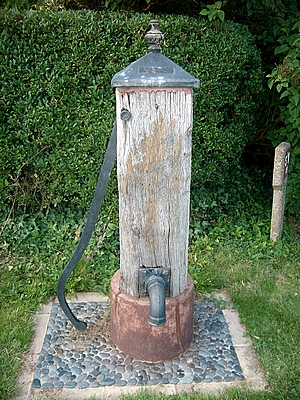
The tiny scullery had stone floors with a coal or wood fired boiler in the corner.  Water was pumped into the cottage by means of a hand operated pump mounted beside a shallow stone sink.  This was quite a convenience compared to many families who had to carry buckets to and from the village pump.

                                           courtesy of wikimedia creative commons licence.

Behind the cottage was a long vegetable garden with row upon row of green produce.  At the end of the garden, surrounded by stinging nettles, was the thunder box  (WC).
Stone floors, Oil lamps, a wall oven and chamber pots were more than enough for all our daily needs.

Eventually Dad was able to rent a small cottage behind the village bakery and for the next few years we were awakened to the smell of fresh bread every morning. 

Some time after the war had ended we moved back to Norwich. The old house had been repaired with different coloured bricks to the originals.  Red rustics at the front and cheap War Damage "Flettons" at the back.  But we did have the luxury of running water at the turn of a tap, electric lights and flush a toilet, even if it was outside.
In our oddly coloured house I spent the remainder of my childhood.   Along with the other urchins from the neighbourhood I proudly shared ownership of the "bombed site" at the bottom of our garden.  The remains of the "bombed out" cottages provided an endless source of material to build dens and light fires.  

The two environments could not have been more different and as the old saying goes - "You can take the boy out of the country but you can't take the country out of the boy." 

In subsequent years we made regular visits to see "Nanny Rawlings" in the little cottage we had once called home.   We did not have a motor car so we travelled by steam train on the old M&GN line.


Passing  horse- drawn sail binders in the harvest fields and row upon row of wheat sheaves lining the golden stubble in perfect symmetry.
Standing guard over freshly sown acres were sad, lonely old scarecrows dressed in farm labourers "cast offs" and condemned to a  life of solitude.
Heavily laden trees lined the orchards while herds of cattle and flocks of sheep grazed contentedly in the meadows.  An endless stream of these rustic images drifted past the carriage window shrouded in wispy steam.   It was like travelling back in time but those images became indelibly etched in my memory.

                                        courtesy of wikipedia creative commons licence.

Sadly progress is a fearsome animal with a voracious appetite, it devours the years without regret or conscience.  Then one day we realise that the people and things we once knew and loved are gone, and sadly, we hardly notice their passing.  I suspect this is the reason  I embarked on this film odyssey.


To watch "My Norfolk Year" video.
http://www.youtube.com/watch?v=4y_Ova5fHNE&feature=plcp