Sunday, 8 May 2011

A Wherryman's Tale

The mist swirled off the river by Carrow Bridge masking the gas lights along King Street on the Norwich waterfront.  A yellow light spilled from the window of the public bar of the "Cinder Ovens" tavern.   Pipe smoke drifted in thick layers above  the wherrymen who supped their ale and exchanged yarns.
Behind the "Cinder Ovens" was a coal yard where the wherries "Bessie" and the "Robert and Emma" were moored.   
That was 1881.  


I don't know if this is the source of my interest in wherries and waterways for I have never owned a boat, or learned to sail.  But for some obscure reason I am driven to create a film record of the East Anglian waterways and their history.
As a child I listened to stories retold by my (Great) maiden aunts over endless Sunday  teas at their little terraced cottage.  Stories about wherries and the boatmen of Carrow.   I did not know it at the time but  most of the  facts were hopelessly muddled,  particularly the accounts from (Great) aunt Bessie.   Aunt Bessie was a wise and worldly "Victorian" lady. She had a glass eye and enjoyed her jug of stout every day. One of the high spots of my young life  (I guess I was about 8 or 9) was the day she entrusted me with collecting her stout from the "snug" of the "Bull".
The white ceramic jug, which held four gills, would be strategically placed on the mahogany dining table in the parlour.  Beneath the stuttering gas lamps the grown-ups played Newmarket or Napoleon for pennies, while the young'uns watched.   Aunt Bessie would study her cards and sup her stout,  maybe she was concentrating on the cards rather than the stories, or maybe it was the stout. Whatever the reason she was constantly being corrected or contradicted by her sisters.   In spite of the inaccuracies great aunt Bessie told of the family connections with wherries and various other boats at Carrow.    It was only years later when I studied our family history that I was able to unscramble some of  the facts.

My Great, Great Grandfather, Robert Hipperson was the landlord of the "Cinder Ovens" from 1868 until his death in 1886, (Cinder ovens were kilns  that burned coal dust swept from the cargo holds of wherries and colliers to make coke for the malthouses.) he also owned the coal yard and both wherries.   He named the "Robert and Emma" after two of his children -  Emma was my Great Grandmother.
Great Great Grandfather Robert hired skippers to bring coal from Yarmouth to his yard in Norwich.  I was told that  wherries would be beached  beside the colliers on Yarmouth beach and the coal transferred  before the tide turned and the wherries refloated.  I have no idea if this is true or even possible.

Robert operated two 37 tonners, a round trip to Great Yarmouth would take about two days if the wind and tide were in their favour.  That would be a lot of coal to sell from his horse drawn coal carts that operated around King Street and Magdalen Street.  I think it is safe to assume that he would also have supplied coal to some of the factories on the upper reaches of the Wensum for their steam power and possibly the new gas works by Bishop bridge.


 Cargoes of "Shruff" (oak sawdust) from the Norwich sawmills were often carried on return trips to Great Yarmouth.   Tons of  "Shruff" were burned in the Yarmouth smoke houses to smoke Kippers and the famous Yarmouth Bloaters.  Sometimes they brought sand from Great Yarmouth instead of coal.  In those days there were no carpets or linoleum, sand was used on the stone floors of most taverns and private houses.  Robert sold sand from his yard at the rear of "Cinder Ovens".  A ha'porth (a halfpenny) would buy enough for an average week's supply for most houses.

Robert was a self made man.  Born the son of a Brickmaker in 1828, he worked as a labourer at Carrow.  He became a wherry skipper by the time he was twenty-nine.    How he managed to acquire enough money to start his own business is a mystery.  Wherrymen did not earn a great deal of money and  his father died in Swainsthorpe workhouse so there was no inheritance. 

Robert was a hard, uncompromising Victorian.  This was demonstrated  by an incident that ended at the law courts.  One of his carters was drinking in "The Tiger" tavern with the proceeds from the coal sales.  When Robert heard this he went to the tavern collected his horse and cart and sent for the local constable.  The carter was arrested and charged. 
 Robert died in1886, aged 56, his wife Isabella, my great, great grandmother, took over the pub and the business.   The "Robert and Emma" was sold to the Yarmouth coal merchants Bessey and Palmer, I believe she was eventually de-masted and used as a coal barge.    Robert was the last registered owner of the "Bessie" but I have no idea what happened to her after his death.  "Bessie" was probably sunk in some remote dyke and left to rot which was the fate of many old "traders" at the turn of the 20th century.

My  Great, Great, Great Grandfather  William Lefevre lived in the "waterman's" quarter of King Street, Norwich.  He  owned the  wherries "Fortitude" and "Endeavour" in 1795.  
The"Fortitude"  was a small 17 tonner while the "Endeavour" was a 37 tonner.  The ""Fortitude was advertised for sale or lease in 1782 as a "hatched" wherry, not all all wherries were"hatched" at this time.
William, like Robert, was also a coal merchant as well as a wherryman.
All Robert and William's vessels are recorded in the book  "Black Sailed Traders".


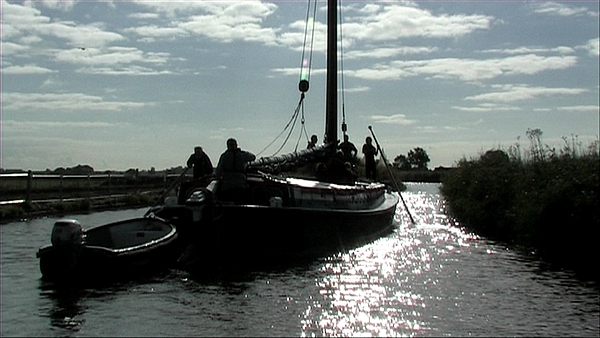
Now several generations on I am following in the wake of the surviving wherries with my camera, it seems some things never change.   I have already learned that "wherry-time" still applies.  I guess it came about many years ago when wherrymen were governed by wind and tide rather than any clock.   I have literally waited for hours to shoot a few seconds of  "Hathor" "Albion" and most recently "Maud".  I have been  roasted by the midday sun, drenched by summer storms and buffeted by gales while waiting for wherries to show.   The great gaff rig and pennant  visible for miles across the flat Norfolk countryside.  Heading first in one direction and then another never seeming to be getting any closer.  Then suddenly they appear and almost as quickly they are past and gone like spirits from another age.  My reward a few more seconds of precious film.

Wednesday, 27 April 2011

Plough Monday at Rumburgh Buck.

7PM Monday 10th January 2011.
If it was not the coldest night of the winter then it had to be a pretty close second.   The road sparkled with frost as we left Norwich and made our way to Rumburgh in Suffolk.  We were on our way to film the "Old Glory" Molly Dancers and Musicians who were celebrating Plough Monday at "The Buck". 

To produce a film covering the history of the Norfolk and Suffolk waterways it is necessary to look at a much broader canvas than just the rivers, broads and estuaries.  The waterborne trade relied heavily on an agricultural economy which embraced both arable and livestock farming.  To add some perspective to the film was the reasoning behind our visit to Rumburgh.  Not only did it add perspective it also added a fair helping of drama.

Plough Monday  is the first Monday after twelfth night.  Historically it was a time when gangs of plough boys would blacken their faces and haul a plough round the parish calling out  "A penny for the plough boys".   The men would blacken their faces so they should not be recognised by the landowners and farmers who employed them throughout the year.  Winter was a very harsh time of  year for the labouring classes, at a time when there was little or no work available a few extra coppers would help to put food on the table.

The "Old Glory" Molly Dancers and Musicians have researched and revived traditional dances that were once performed in and around the Eastern Counties, particularly in Suffolk.  The dancers are attired as labouring men right down to their hobnail boots.   There is an air of menace about them just like the plough boys of long ago, the flaming torches that illuminate the proccession, add to this atmosphere.  One hundred years ago any skinflint who did not part with a copper or two,  would awake next morning to be greeted by a single furrow drawn across their lawn .

The Dancers assemble at the church of St Micheal and St Felix where the plough is blessed the day before (Plough Sunday).
The church bells were ringing out as the torch lit procession made its way through the churchyard.  Everyone dressed in black gave a distinct funereal feel to the proceedings.  The dancers are led by the "Broom man" who clears the way for the dancers.  Behind him the Lord of the dance and his Lady (traditionally the lady is always a man), they are followed by the "Box Man" (with the collection box) and the "Whiffler" (the Molly's sergeant at arms).   The column turns into Mill Road and heads toward "The Buck". The plough, hauled by two black faced Molly-men, grinds and rattles over the tarmac.  "Old Glory"  not only create wonderful theatre but it re-creates the past, bringing history to life.  
  Up until the turn of twentieth century the Molly dancers accompanied the plough boys around the parish and performed dances for a small reward.  Whereas the Molly dancers are all men, the musicians are all women, they too have blackened faces and play a variety of instruments.  Their traditional music adds another dimension to the event.
 At the "Buck" a large crowd had gathered, and in spite of the "wind frost" the dancers stripped down to their shirt sleeves and performed their robust routines.   The sound of their hobnail boots crunching on the gravel of the car park in perfect time to the music has echoes of a bygone era.  They have been described as Morris dancers with menace. You can forget jingling bells and white handkerchiefs, these guys look as if they could use a pitchfork and handle draught horses if they were asked.
There is a great deal of history attached to the Molly dancers, dating back long before the reformation.  At that time the church encouraged the farm workers to collect money during this period, some of the money collected would pay for an eternal flame to be left burning in the parish church all year round.  The plough has symbolised man's dependence on the earth since pagan times and this has carried on to the present day.

If you have never seen them check their website and catch one of their performances - it is well worth the effort.  "Old Glory" only give about twelve performances each winter but they have a very large and   enthusiastic following.  "Snape Maltings", "Geldeston Locks" and "Rumburgh Buck" are possibly the most popular venues .
It was too dark to get a shot that would do justice to the the lady musicians at Rumburgh so I have included a shot from Bungay Christmas Fayre where we filmed a month earlier. 

Friday, 8 April 2011

A Norfolk Sunrise,

A definite bonus for shooting sunrises around Norfolk and Suffolk is to simply experience the views and to absorb the sounds and  fragrances of an early morning.

Add a crisp frost to the golden mix, even the cold air nipping at my fingers cannot spoil such a morning.  Without a living soul for miles, surrounded only by solitude and the sounds of nature.  Through the of eye of my camera I capture the atmosphere enshrined in the brittle light.   


It is 6.30 am and I have been out for an hour, carrying twenty six pounds of equipment across Buckenham marshes.   The sky is filled with the cries of a thousand geese, but the air is still,  without a murmer of a breeze.   The reeds stand upright,  there are no ripples on the water.  If you desire tranquility and perfect peace then it is here.


As enchanting as the landscape is - there is work to be done.  The purpose of the early start is to re-create the notion of a  bygone age, a time when my great grand parents were children.   A time before telephones, computers, electricity, railways and motor cars.   In our time of plenty it is difficult to fully comprehend how difficult life was in old Norfolk.    There are very few visual reminders of  Norfolk's labouring classes apart from those found in museums.  Proof that they only took as much as they needed which was never quite enough and they left the landscape almost as they found it.   There are a few places that have escaped the onslaught of this modern age and remain relatively unchanged, they are the wetlands and marshes.  Not as wild or desolate as they once were, but still remote enough to spur the imagination to connect with a time long gone.  A time when Eel-catchers and Reed-cutters sustained large families in tiny isolated cottages.   A time when Wildfowlers paddled silently on the inland waterways and estuaries and a time when wherries glided across the rivers and broads, carrying the needs for everyday living.


Researching my family history has uncovered  farm labourers, horsemen and wherrymen.  With exception of the wherrymen, none of them probably set foot outside Norfolk in their lifetime.  They would rise with the sun and work until nightfall.  There was no unemployment benefit for them, only the workhouse.   There was no rest in retirement, they worked until age robbed them of their strength.    My life is easy by comparison, yet out on the marsh  I can share  the same sights and sounds they experienced all those years ago.   It is a bridge across time and sets the opening of the film in context.  A documentary of life and legend in and around the East Anglian waterways.
It has been a good shoot.  As I retrace my steps across the marsh skeins of wild geese pass noisily above me. The frosted meadow grass crunches gently beneath me.  I am cold but very pleased with my mornings work.   I have captured a wonderful Norfolk sunrise.


Monday, 4 April 2011

St Benets by Wherry

Any film that aspires to portray the history of the Norfolk and Suffolk waterways must include the legendary "Black Sailed Traders", the famous Norfolk wherries.
On Sunday August 1st 2010 my friend Steve took me out in his boat to shoot film of the "Albion" under sail.    We planned to follow the wherry from Womack to Ranworth where arrangements had been made for "Albion" to collect the Bishop of Norwich and take him to St Benets Abbey for the annual service.
I had intended to film the Bishop's arrival at the abbey twelve months earlier when he sailed on the "Hathor" but I was unable to cover the event.
We set off at about 08.30 in bright sunshine - a truly glorious summer's day.  There were already quite a number of boats on the Bure as we made our way to Womack water and the "Albion".

At Womack we spoke to Henry, one of the "Albion" skippers, to establish what was  allowed and what was forbidden while we accompanied the wherry under sail.  From a filming point of view there were a few issues  to be addressed.  Mounting the camera on a tripod was out of the question as the engine vibrations would be transmitted to the camera and produce camera shake.   Our strategy  was simple - hand held camera - wide angle lens - get in close.
Following "Albion" out of Womack water clearly demonstrated some of the problems that would persist throughout the day.   Our first attempt to get alongside was blocked by fishing poles that seemed long enough to reach the opposite bank.   Steve, a keen angler himself, quite rightly respected the etiquette of the river and waited for a fisherman-free stretch of water.    Each time we found one there was usually a cruiser travelling toward us so all we could do was follow "Albion" until we reached the Thurne.  This in itself was not easy,  the little "Norman 20's" lowest comfortable speed was some-what quicker than "Albion's" rather sedate rate of progress.   While astern of us an ever growing flotilla of impatient cruisers and sailing dinghies swarmed, tacked and milled around us.

When we reached the Thurne it was like uncorking a bottle of champagne, craft of every shape and size hurried past us.  It  took an age until we were more or less on our own with "Albion"  and able to position our  boat and finally shoot some film.    It was no surprise that the first week in August  was going to be a busy period on the Broads but I had not expected anything like the volume of traffic we encountered.   Any clean shots of just "Albion" were few and far between, and to pass her sixty-five foot hull  kept  us on the wrong side of the river for longer than we would have liked, especially when there were  cruisers approaching us, at times three abreast.    Steve had to keep his wits about him all the time to avoid getting trapped between "Albion" and the bank while allowing dinghies to tack across our bow.


It was certainly an interesting shoot.  By far the best camera angle was over the starboard side which gave a good clear field of vision, but this meant we on the wrong side of the river for long periods.  Shooting over the port side was restricted by Steve at the wheel which meant the only angle was from amidships to astern.  The very worst angle was shooting over the bow of the Norman.  It required me to climb up and shoot over the cabin roof making sure not to get the bow rails in shot.  On more than one occasion a sudden change in direction or speed caused me to lose my balance which produced more than one heart stopping moment.   I was acutely aware that I had the security of a life jacket but the camera did not, that would have been one very expensive splash. 


"Albion" cruised serenely on her way toward Ranworth with cruisers and dinghies dodging out of her path.  We shot "Albion" from every conceivable angle as we made our way along the Bure.  At around midday we moored alongside  "Albion" for  lunch and awaited the arrival of the Bishop.

After lunch "Albion" cast off, with the bishop on board,  raised sail and headed for St Benet's.   If we thought the river was busy during the morning we had a nasty surprise in the afternoon.  The Bure was like the M25 on a bad day.   The best we could do was to keep station astern  of the old "trader" and grab whatever shots became available.
The bishop took the helm of  "Albion" and led the flotilla of assorted craft toward St Benet's.

The closer we got to the abbey the more crowded the river became.   Every available mooring was taken and the abbey precinct was heaving with worshippers.   "Albion" was directed downstream to the old quay heading that was crumbling and devoid of mooring posts.   The BA launch waved us through with "Albion" and I got the best shots of the day.


I had asked another friend  to shoot some film from the abbey precinct.   Some where amidst the melee of cameras, spectators and a brass band he was able to record the bishop coming ashore.   A storm had been threatening for most of the afternoon and the overcast sky grew darker and darker.   I am not a religious man but there was something surreal about the whole event,  St Benet's acquired an eerie atmosphere, almost biblical.    Should you ever  find yourself in the area of St Benet's on the first Sunday in August take the time to attend the service.   It is an experience you will never forget.

With "Albion" securely moored and the bishop safely ashore our days work was done.
Steve steered the Norman away from St Benets and headed for home as lightning flashed and thunder rumbled behind us.

Thursday, 31 March 2011

Oh Brother!

To make low budget films successfully requires a little creative endeavour, a fair amount of luck and a great deal of determination. 
Recently I had to find a medieval monk, a dog, a rowing boat and a trailer for a short re-enactment sequence of film.  Fifteen seconds to be exact.
I was offered an old wooden rowing boat which was perfect for the medieval period.   I had a volunteer to play the part of the monk so all I needed was a dog that was comfortable on the water.   I am a keen follower of the Norfolk Broads Forum, my daily visit keeps me abreast of the latest Broadland news and events.   It seemed the obvious place to track down a boat friendly hound.     In less than an hour I had received an offer from Lisa who assured me her terrier "Miss Leigh" was a natural sailor and was available for the project.
Not only was Lisa willing to help but she also extended her holiday on the Broads by two days to make the shoot possible.

Everything had fallen into place with unprecedented ease by the time my dear wife was putting the finishing touches to the monk's habit.
The day of the shoot dawned - not as good as the forecast but good enough.  Right on time the boat and trailer, the monk and his assistant, trundled onto the car park by the slip way.  While the boat was being unloaded I was informed that the boat had not been in the water for several years.
"Will it float?" I asked.
"Probably" came the reply.
Some life saving equipment was inflated and made ready for any emergency that might arise.  As necessary as the flotation aids were, their presence did nothing to lessen my apprehension.  I tried in vain to rid myself of the vision of a medieval monk clinging to the wreckage of a sinking rowing boat.   

Several unsuccessful attempts were made to fit the rowlocks to the boat using files, sandpaper, knives and screwdrivers.   None of the aforementioned worked so plan B was pressed into service - rope rowlocks?   It probably would have been okay if the monk's assistant had not left the rope at the boatyard.   Fortunately there was a plan C.   Leather laces were removed from the monk's assistant's boots - and some very robust rowlocks were fashioned from them.


At last the boat was launched - immediately the ancient craft began to fill with water.   "It will be okay once the water swells the wood" said the monk's assistant.   I was pleased to hear this theory but was not totally convinced and my vision of a sinking monk returned..    Very soon the monk and Miss Leigh were aboard and rowing up stream toward the camera position.
As the boat filled with water miss Leigh tried to get on the monk's lap in order to keep her feet dry, this made it impossible for the monk to row the boat.  The  monk, dog and oars  became hopelessly entangled  as the boat drifted toward the bank.


"Cut!"
The boat was returned to the slipway to be baled out.
After everyone had re-grouped the Monk rowed upstream once again with miss Leigh in the stern, as before the bottom of  boat quickly filled with water.  The boat made a single pass when the boot laces that formed  the make shift rowlocks gave out with a thud.   Before the Monk had regained his balance  Miss Leigh had abandoned ship and swam for the shore.  That is one very smart dog!


"Cut!"
The boat had to be quanted back to the slipway for repairs and more baling out.
For the third time the monk set off with the ever patient, but by now,  very wet  Miss Leigh in the stern.
This time the boat made two perfect passes while miss Leigh behaved exquisitely for the camera.
"Cut!"
I had my fifteen seconds of film thanks to a very determined group of people.

Saturday, 26 March 2011

A New Beginning.

At sixty eight years old I guess the average person doesn't get too many new beginnings.      For me, my sixty eighth year has given me my independence and the chance to do the two things I love best.  Make films and explore my beloved Norfolk.

For the last two years I have been working on a labour of love.  Recording the history of the Norfolk and Suffolk waterways on video and capturing a forgotten way of  life that once sustained the men and women of these counties.
Eel catchers - Wherries - Wind mills -  Reedcutters - Wildfowlers  and  Norfolk Thatchers can still be found,   but they are becoming  very  rare .

This labour of love has been work in progress for the last two years and is likely to take at least another twelve months before it is completed.   I would like to share this video adventure with you through the wonderful world wide web.    Amuse you with the lengths I have (and am ) prepared to go to in order to capture the sequences I believe are necessary.  Share the frustration of  the shots that got away.  Show my appreciation for the folks who have gone out of their way to help me.

Photographs and video clips will be included in future blogs.