Saturday, 29 October 2011

A Film Odyssey.

When I am not lugging camera equipment around the more remote parts of Norfolk and Suffolk I often ask myself why on earth am I spending so much of my time shooting a film which only a handful of people will  see.  Then, in my quieter moments I try to figure out  what drove me to start out on this film odyssey in the first place.

Somewhere in the sunlit uplands of my memory I recall my early years in a little village in west Norfolk.
One night in April 1942 the Luftwaffe destroyed our family home in Norwich just a few weeks before I was born.

                                      courtesy of wikimedia creative commons licence.

We were evacuated to the sanctuary of the rolling farmland of west Norfolk where a kindly old couple took us in.  The old couple became my adopted "Nanny and Grandpa Rawlings"  My newly acquired  grandparents were good old Norfolk stock.  "Grandpa" was a big man and as strong as an ox but had a gentle demeanor .  "Nanny" was a slightly built woman with an air of understated independence.  They did not have very much but were contented and quite happy to share what little they had.

I guess we didn't take up too much room as most of my parents possessions had been destroyed along with the greater part of the house.  This was just as well as the new home we shared with the Rawlings was a tiny terraced cottage with just two small bedrooms.   The front door of the cottage stepped down off the main street onto the stone floor of the parlour.  The parlour was small but uncluttered apart for a modest collection of  Edwardian china ornaments.  An enormous oil lamp occupied pride of place on a plain, unvarnished, wooden table.  Two wooden chairs with crocheted cushions faced an open fireplace.  On one side of the fireplace a huge soot encrusted  kettle was in perpetual steam.
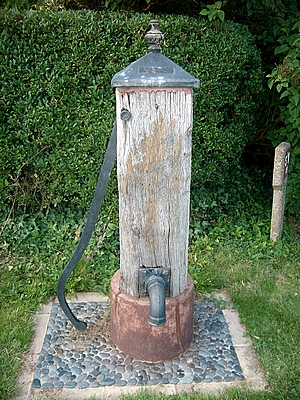
The tiny scullery had stone floors with a coal or wood fired boiler in the corner.  Water was pumped into the cottage by means of a hand operated pump mounted beside a shallow stone sink.  This was quite a convenience compared to many families who had to carry buckets to and from the village pump.

                                           courtesy of wikimedia creative commons licence.

Behind the cottage was a long vegetable garden with row upon row of green produce.  At the end of the garden, surrounded by stinging nettles, was the thunder box  (WC).
Stone floors, Oil lamps, a wall oven and chamber pots were more than enough for all our daily needs.

Eventually Dad was able to rent a small cottage behind the village bakery and for the next few years we were awakened to the smell of fresh bread every morning. 

Some time after the war had ended we moved back to Norwich. The old house had been repaired with different coloured bricks to the originals.  Red rustics at the front and cheap War Damage "Flettons" at the back.  But we did have the luxury of running water at the turn of a tap, electric lights and flush a toilet, even if it was outside.
In our oddly coloured house I spent the remainder of my childhood.   Along with the other urchins from the neighbourhood I proudly shared ownership of the "bombed site" at the bottom of our garden.  The remains of the "bombed out" cottages provided an endless source of material to build dens and light fires.  

The two environments could not have been more different and as the old saying goes - "You can take the boy out of the country but you can't take the country out of the boy." 

In subsequent years we made regular visits to see "Nanny Rawlings" in the little cottage we had once called home.   We did not have a motor car so we travelled by steam train on the old M&GN line.


Passing  horse- drawn sail binders in the harvest fields and row upon row of wheat sheaves lining the golden stubble in perfect symmetry.
Standing guard over freshly sown acres were sad, lonely old scarecrows dressed in farm labourers "cast offs" and condemned to a  life of solitude.
Heavily laden trees lined the orchards while herds of cattle and flocks of sheep grazed contentedly in the meadows.  An endless stream of these rustic images drifted past the carriage window shrouded in wispy steam.   It was like travelling back in time but those images became indelibly etched in my memory.

                                        courtesy of wikipedia creative commons licence.

Sadly progress is a fearsome animal with a voracious appetite, it devours the years without regret or conscience.  Then one day we realise that the people and things we once knew and loved are gone, and sadly, we hardly notice their passing.  I suspect this is the reason  I embarked on this film odyssey.


To watch "My Norfolk Year" video.
http://www.youtube.com/watch?v=4y_Ova5fHNE&feature=plcp

Saturday, 8 October 2011

Smugglers

Skippers of wherries could earn more from carrying one or two tubs of  smuggled French brandy than they could from hauling forty tons of coal.   In the early part of the nineteenth century smuggling was rife, even severe punishments did not deter wherrymen from carrying "Little extras".   Imprisonment at best or transportation at worst.  In the early 1800's transported prisoners were sent to the swamps of Africa which was practically a death sentence,  transportation to Australia came many years later.  Once contraband was seized the wherry would be burned even before the felons had been sentenced.
For the wherrymen moving contraband along the waterways was much needed income but they were only on the fringe of the "Free Trade" industry.
Romantic notions have become attached to 19th century smugglers which is far from the reality of the period.
Smuggling barons were ruthless violent men who became rich from their criminal activities and they would not hesitate to deal with anyone who stood in their way.

We took the cameras to West Norfolk to record a dramatic event that took place in September 1784.

Smugglers were waiting off shore for the all clear signal from the cliffs at Old Hunstanton, they did not know that customs officers and a troop of Dragoons were waiting for them in the darkness.  As the contraband was being brought ashore the Dragoons charged across the sands at full gallop with sabres drawn.  The smugglers, upwards of fifty men, scattered in all directions.
The smuggler's carts and ponies that had been abandoned on the beach were commandeered by the excise men and the smuggled goods were taken to nearby "Clares farm" which is now part of the Caley Hall hotel.

Reinforcements of Dragoons arrived at Old Hunstanton and were sent to the beach in case another attempt was made to land more goods.
The gang leader of the smugglers was enraged when some of the landing party returned to the lugger and  gave him the news of the customs seizure.   Without hesitation he armed the remainder of his crew with pistols, muskets and sabres, the long-boat was launched and the smugglers set off to recover the contraband that had been seized.

As the smugglers made their way from the dunes they spotted the advancing column of dragoons and concealed themselves in a ditch.  The column passed at close range, the smugglers opened fire, private William Webb at the head of the column was hit four times and fell from his horse.
A second volley fatally wounded customs officer William Green who died hours later at Clare's farmhouse.
By the time the Dragoons had regrouped the smugglers had fled.  The gang leader, William Kemball, was later apprehended along with most of the gang.  He was held in Norwich prison until the Thetford assizes seven months after his arrest.  Ironically the wealth accumulated from smuggling activities afforded him first class legal representation which allowed him to escape the death penalty and resume his smuggling career.


This sad little story is not uncommon in Norfolk.  There are three customs officers buried in St Nicholas' churchyard, Great Yarmouth.   Seven other revenue officers were wounded in the same action that was fought off the Yarmouth coast.   There is another officer buried in Bacton churchyard.  All of them killed them by smugglers.


We ended the shoot at the little village church where we filmed the graves of the Dragoon, private Webb and the Customs officer William Green.  
As we stood at the graveside it was not difficult to imagine young Phoebe Green standing there all those years ago, a widow at twenty three.


Friday, 16 September 2011

Mills

A common sight for travellers in Norfolk and Suffolk are the old drainage mills.  Travel by road, rail or river and there is usually one of these relics somewhere on the horizon.   The location of the mills out on the windswept marshes are yet another reminder of East Anglia’s forgotten past. 
In the mid 1800s there were 240 drainage mills working in Norfolk, today about 70 remain.  The majority of them have fallen into disrepair and are now unloved and unwanted. 


Beside the river Yare, (or the Norwich river as it was called by the old wherrymen), stands Hardley mill.
The mill was built in 1874 for Sir Thomas Proctor Beauchamp of Langley Hall.   The mill was in operation until the 1950's when it was "tail winded" and extensively damaged.    The Internal Drainage Board abandoned Hardley mill and replaced it with an electric drainage pump.  Hardley mill became another unwanted,  redundant wind pump.   

We took the cameras there last Autumn to shoot some film - as we approached the mill we could see the sails rotating majestically in a fairly light breeze.  There is something very "Norfolk" about a windmill.  A sentinel working in splendid isolation out on the marsh.   A symbol of reliability that belongs to another age,  not polluting earth or atmosphere, a machine in perfect harmony with nature.  
Without the drainage mills thousands of acres of valuable grazing land would have been permanently under water.  Low lying Marshland pastures were drained by a network of dykes which carried the water  to the mills which returned the water to the river.  
Early drainage mills pumped the water by scoop wheel until these were replaced by turbines.  The turbines could lift around twelve tons of water per minute.


Hardley mill has undergone an incredible transformation  -  The ultimate plan is to restore Hardley mill to full working order when it will once again pump water.   We were invited to take our cameras to the very top of the mill and sample the wonderful view.  The climb was a challenge even with just the minimum of equipment.   The lower floors were relatively easy, but where the tower narrowed on the third and fourth floors it became more of a squeeze.  Finally we emerged on the platform of the mill cap by way of an iron ladder which rotates as the cap turns with the wind.   The view was spectacular from every quarter - the marsh rolling out beneath us with the Yare, a glittering silver ribbon, winding through it.  
The giant sails rotating ponderously through their arc, their creaking timbers bringing the mill to life as the power resonated throughout the tower. 


Although the the drainage mills were primarily used to drain marshland they did have other uses.   Wherry skippers found the mills useful to hide contraband making it's way along the rivers.  There was more profit in a single cask of French Brandy than forty tons of coal.   Mill men would warn the wherries if the Excise men were in the area by stopping the sails in the cross of St George or the cross of St Andrew.  One signalled danger and one signalled all clear.  The message could be passed across the flat Norfolk landscape faster than any horse and rider. 

A short video can be viewed on the link below.
http://www.youtube.com/watch?v=ovE7zWvumbs
or click on "My favourite links" on the right of the blog.
Thanks for looking
Jonno


Friday, 5 August 2011

"Hathor" Forget Me Not.

Yesterday I called in to see an old friend, she is one hundred and six years old.      I last saw her two years ago when I shot some film of  her on the Norfolk broads, she was very sprightly for her age and fun to be with.   When I called at the home she shares with two other Edwardian ladies I was shocked to she how she had deteriorated.  Her decking was cracked, her varnish had peeled and she looked very, very sad.   I am writing about  the pleasure wherry "Hathor".

Two years ago I spent the summer shooting a documentary of  "Hathor's" farewell tour across the Norfolk rivers and broads.  During that summer as I followed "Hathor"  I became more and more attached to her.  The sleek graceful lines seemed out of place for what was originally a robust cargo design.


"Hathor" is a silent witness of a time when local craftsmen created things of lasting quality for very little reward.  She is also a reminder of the enormous social divide that existed in England during the Edwardian period.  A time when the affluent, unashamedly, enjoyed their wealth and the rivers and broads became their exclusive playground.  For the working classes who served them it was an existence, measured by long days of  hard work and very few pleasures.


"Hathor" is a very special craft with a fascinating history.  She was built by Daniel Hall of Reedham in 1905 for Ethel and Helen Colman daughters of Jeremiah Colman (Colmans Mustard).  In 1897 the Colman family travelled the Nile on an Egyptian river boat named "Hathor",  during the trip Alan Colman became gravely ill and died in Luxor.   Seven years later the Colman pleasure wherry was named "Hathor" in Alan's memory.  The interior is inlaid with Teak and Sycamore creating an Egyptian theme throughout the saloon and cabins. 

It is now two years since "Hathor" sailed  the rivers and broads and she is likely to be absent for the foreseeable future.  A friend in need is a friend indeed and "Hathor" is in urgent need of  friends.  Considerable funds are needed to restore her to sailing condition.   Please visit the WYCCT website to learn more about this wonderful old wherry and,  if you so desire, sign up as a friend.

"Forget me not" 
Hathor.

  http://www.wherryyachtcharter.org/
     or you can use the "My Favourite Links"  on the right.

I have included some clips from "Hathor's" farewell tour which can be seen on Youtube.
     click on the Youtube link in "My favourite Links" on the right.


Wednesday, 27 July 2011

Breydon

Sunday 24th July  2011.

The first time I saw Breydon water was many years ago as a child, it was an August bank holiday.  Mum and dad, armed with a shopping bag full of sandwiches and orange juice, took us kids to Great Yarmouth for the day.    The train steamed along the edge of Breydon water where wading birds foraged in the mud  and the green grey water ebbed out through the channel.  I looked out of the carriage window completely captivated by this mysterious stretch of water and vowed I would cross it one day.

More years than I care to remember have flown by since I made that promise to myself.  It is more than likely I would not have made the trip this summer had it not been for the fact that the wherry "Maud" was scheduled to cross Breydon,  it was a film opportunity too good to miss.

First priority was to find a boat and skipper.  I posted on the Norfolk Broads forum to see if anyone could help, within an hour I had three offers.   I accepted Lord Paul of Sealand's kind offer and for the following two weeks watched the long range forecasts for Great Yarmouth with more hope than expectation.


The day of the shoot arrived and I met up with Lord Paul and "Mistral" moored at the Fisherman's Inn, Burgh Castle.   We chatted over a cup of coffee while we waited for low tide and a call from the "Maud".  The call duly arrived and we set off  for the New Haven Bridge.   It took an hour to cross Breydon and fulfill at least one childhood ambition.


                                                   It was a perfect day for yachtsmen.

It was a perfect day for yachtsmen. a North Westerly was cutting across Breydon at 34 kph raising white caps and buffeting "Mistral" who rode serenely through water.
As we approached the New Haven Bridge we could see "Maud"s great black sail away in the distance, everything was falling into place.  We arrived at the bridge and waited for "Maud" to appear, then we got another call.  The wherry could not get under Vauxhall bridge, so they would have to wait for low water and try again the following day.  

Lord Paul turned "Mistral" about and headed back to Burgh Castle,  We were both disappointed to say the least.  To make it worse as we returned across Breydon the sun broke through and the wind moderated - perfect conditions for filming.  Even though I had failed to get the shots I came for I enjoyed my day out with Paul on "Mistral"

                                                         Perfect conditions for filming.

Plan B was quickly put together.  Lord Paul and "Mistral" were leaving Breydon on the morning tide so my only option was to shoot the wherry from the Breydon wall this was assuming they could get under Vauxhall bridge.

Next day  (Monday 25th  July) A North Westerly gusting to about 30 mph - very dull with fine drizzle at times.
Conditions for filming absolutely atrocious.
I parked at Church Farm, Burgh Castle, loaded my trolley with equipment and set off for the Breydon wall.
After a hike of about a mile and a half I found a spot which gave a good view in both directions, I set the camera up got out my folding chair and waited - and waited - and waited.    Then the call from "Maud" - they were still waiting at the Vauxhall bridge.   The tide was rising - the wind was strengthening - the light was getting dimmer by the minute and my spirits were fading with the light.     I pulled my collar up, turned my back to the wind and waited alone on the Breydon wall - for two hours - in a gale - I must be nuts! 
Then another call from "Maud" they were under the bridge and on their way.  A few minutes later I could see her sail in the murky distance.     Very slowly "Maud" approached the headland where I was waiting.  A fine drizzle was blowing straight onto the lens,  the gusting wind rocked the camera making it impossible to take a steady shot on the 20x zoom.  "Maud" was well within range - if only there was a break in the cloud and a gap in the wind, I would have settled for just thirty seconds - but no such luck.   I knew it was going to be difficult to get anything at all in these conditions.


The wind did not relent, the light did not improve - but I did  get a few worthwhile shots.  Good enough to include in the film?  Probably not.    But "Maud" has to make the return trip across Breydon and I shall be waiting. 


                               "Maud" hauled out for maintenance at Burgh Castle.


Many thanks to Lord Paul and the owners and crew of "Maud" for their help and support through a very tough weekend.       For my part it has to go down as an heroic failure.


Sunday, 10 July 2011

Buxton Mill to Aylsham Mill by Canoe.

Wednesday June 29th 2011.

It was barely nine - thirty in the morning and the sun was already uncomfortably hot.  Insects rose in coloured profusion  from the lush vegetation on the banks as our canoe cut its way through rafts of water lilies and floating grass.  Birdsong echoed around the reed beds and from trees overhanging the river.   This was not a remote mangrove swamp in some far off tropic - it was the river Bure running through Buxton Lamas in deepest Norfolk.

This was the second part of our  journey along the upper reaches of the Aylsham navigation, part one had ended at Buxton mill just shy of halfway.  The second half of the journey resumed at Buxton mill,  and barring obstacles on the navigation, we hoped  to make it all the way to the mill at Aylsham.  When planning the film, against all advice, I had decided to head upstream and finish at Aylsham as this seemed the most logical direction for the film to make any sense, after all it is called the "Aylsham" navigation.  Had we taken the easier option starting at Aylsham and heading downstream it was difficult to decide on a suitable finishing point?     It should be noted that the river is also known as the "Bure" navigation - but  for clarity of purpose I felt the film had to terminate at Aylsham.

Whatever name is preferred the second leg was five and half miles of paddling against the flow on a scorching hot mid-summers  day.   I was very fortunate to have Son Andrew and his mate Andy,  both experienced canoeists,  providing the motive power.  Just the same as the first trip I was up front with the camera, but this time I knew what to expect and was really looking forward to retracing the route of the old wherries

The Bure is surprisingly wide upstream from Buxton mill where, I guess, the water is held up by the restriction at the mill race.   "Bream Corner" so named by the wherrymen is a reasonably fast flowing reach making the the first part quite a tough stretch to paddle.  The water was crystal clear and  I could see fish darting beneath the canoe weaving in and out of the aptly named "Bur Reed"  (I know, it's spelt differently)
We glided past pretty riverside properties set in colourful gardens and dinghies and canoes tied up to lush green waterside lawns.    As we passed Lamas church, secreted amongst the trees, we saw several young jack Pike hiding in the reeds at the waters edge.  We left Buxton behind us and the river wound its way into the countryside through pastures fringed by reed beds and flag iris'.
For the entire five and a half miles we were accompanied by turquoise Banded Demoiselles (Damselflies).  They seemed to be everywhere, landing on the reeds and water lilies as we paddled by. 

Birds warbled all around us as the canoe pushed through the water  leaving Eddy's rippling in our wake.  Dragonflies hovered inches from the surface of the river while butterflies fluttered erratically above the river bank.  We had this little slice of English wilderness all to ourselves - priceless!

It took just under the hour to reach Oxnead Hall,  it's castellated tower looking slightly surreal and out of place against the other red brick buildings.   We passed under a  low bridge, tall trees lined the bank, behind them dense woodland shielded us from the sun until we reached Oxnead mill pool where we beached the canoe.  This was the first obstacle and possibly the most challenging.

It was easy enough getting the canoe out of the water but getting it over a stile and along a woodland path did increase the pulse rate.   Fifteen minutes later we were back on the river and paddling under the bridge at Oxnead heading toward Brampton and Burgh.  This bridge is where the wherrymen would moor their vessels and visit the Brampton "Maids Head" just a hundred yards from the bridge - sadly no longer a hostelry.   In the Brampton meadows a group of curious Hafflinger horses checked our progress as we paddled by.

Several swans had made themselves at home on the navigation, each with a clutch of young.   The Pen would hustle the brood into the bank while the Cob hissed and looked ready for a fight.   If the Cobs looked moody and menacing  we did the same.  This approach seemed to work as we achieved an honorable stand off  every time but if  I was really honest and it had come to a conflict my money would have been on the swans.
We had been on the water about two hours when we reached the deep water at Burgh lock.  The canoe was unloaded very carefully and and the old chap with the camera was assisted onto the bank.  We re-launched our little craft off the wall of the old lock, it was quite a drop.  I sat on the wall ready to lower myself gently into the canoe.  A large thistle biting my rear end did accelerate my embarkation much faster than I had intended.
Burgh church, partially hidden behind burgeoning willows drifted by on our right, there was no time for sight seeing,  "Cradle bridge" the wooden  foot bridge that links Burgh with Brampton was dead ahead forcing us to lie flat in order to pass safely beneath it.   Many years ago "Cradle bridge" was  much higher to allow the wherries to pass unhindered en route for Aylsham.

A little further upstream we approached Burgh bridge, once the site of wherry owner Isaac Helsdon's staithe. A large dog on the opposite bank barked at us, probably not used to people on his turf.  

After Burgh the river narrows markedly,  much of it choked by the encroachment of vegetation.  In some places  rafts of floating grasses reach out from the banks threatening to close the channel completely.   Three hours into our journey we decided to find a suitable place to pull in to stretch our legs and have a cup of coffee.  During this spot of recreation we spotted another three man canoe approaching from upstream, the first people we had set eyes on since we left Buxton. The only living things we had encountered up to then were several angry swans and an angry dog.   They pulled in and chatted with us for a while telling us there was a tree across the river about five hundred yards ahead.  They had only just managed to get under it.  Looking at our slightly larger canoe they thought we would find it difficult to get past. They added that  because of the dense undergrowth there was nowhere to leave he river to get around the tree.  This was not what we wanted to hear, providing we could keep to the correct channel we were less than a mile from Aylsham mill.   It would have  been extremely disappointing if we had to give up when we were this close.

After fifteen minutes we bade the other canoe farewell and headed off upstream.  We soon  found the fallen tree and it was big.  There was only one place we might get under it and that was close to the bank where the trunk formed a natural arch.   I was advised to lay flat.  Like a water-borne limbo dancer I leaned back as far as I could then collapsed onto the bottom of the canoe, wedged tightly and unable to move with the camera on my tummy the trunk of the tree passed an inch above my nose.   Willing hands grabbed branches and boughs and slowly passed the canoe under the tree.   Once clear of the obstruction Son Andrew helped me back into my seat and we set off for Aylsham.


Very soon we were paddling under the by-pass and we could see the the silos at "Dunkirk".   There was one last obstruction to overcome, a fast running weir.   Once again the canoe was unloaded and carried over land,  commando style.

Not surprisingly the engine room was beginning to feel the effects of what had been quite a long haul against the flow.   Soon after the weir we encountered three possible channels, hoping for the best we took the one in the centre which brought us up to the old wherry staithe which is now a very nice housing complex.   Around one last bend and we could see white water coursing through the mill race.  It was job done!

It is almost one hundred years since the navigation was ruined by the floods of 1912.   The locks and bridges were washed away and the days of the wherries on the Aylsham navigation were over.  We are not the first to make this journey and it is not a major achievement in itself, but by completing the route I felt we had relived a little bit of history - and recorded it.

If you would like to see two short videos of the canoe trip from Buxton mill to Oxnead and Oxnead to Aylsham mill the link is attached.
Or you can use the youtube link under my favourite links above right.
http://www.youtube.com/watch?v=ysyEZWQEMZ8&feature=plcp

Thankyou for looking.


Sunday, 26 June 2011

The Volunteer Wherryman.

Rain was spilling from "Albion's" great black sail, cascading across the hatches and collecting on the plankways.  The helmsman steered the wherry through the squall while on the foredeck a group of volunteers clad in waterproofs of every colour seemed largely unconcerned by the weather.   For my part in the proceedings I had the camera safely cocooned in a "High Tech" bin bag and continued filming "Albion's" progress along the Bure.


The "Volunteer's" charter was my fifth trip on "Albion" since I joined the trust a year ago.  It all began with a visit to "Albion's" yard at Ludham to have a look round.   In no time at all I had a mug of tea thrust into my hand and soon after agreed to work as a volunteer.   Being totally unskilled I was a kind of  "Odd Job".   Painting, rubbing down,  black leading the old wherry stove and checking life jackets.  All these tasks no matter how menial are all part of  "Albion's" preservation.


The best way to get sail on "Albion" is to sign up for crew training.  I thought I would give it a go and registered as a trainee mate.   Taking "Albion's" twenty six tons out on a charter is a serious business, safety  for passengers and crew is paramount.  This was constantly emphasised throughout my first training session.
The trainees were shown how to use the quant,  quanting is a very physical discipline which requires technique over brute force.  Personally I found it was somewhere between "very difficult" and "almost impossible".   If you didn't get the quant into the mud on the river bed it just floated up to the surface.     I wondered just how the old wherrymen could maintain this effort  for hours at a stretch  with a fully laden wherry and not even a breeze to assist them.

Raising and lowering  the mast is a drill that has to be carried out in strict order.  The ton of lead at the base  of the 42 foot mast is so finely balanced it takes surprisingly little effort to raise and lower the three tons of Pitch-Pine. That is, of course,  assuming all the necessary locks and pins have been removed .  It is claimed that working wherrymen could lower a mast and shoot a bridge without losing headway - it took we trainees slightly longer.


Next instruction was rigging and raising the sail.  I found raising the sail by far the most difficult of all the tasks, winding the winch saps the strength from your arms and drags the air from your lungs.
By the time I had learned about Gaff lines, Winches and Reefing points it was time for lunch.
After lunch we did a "man overboard" drill.  Recovering the dummy that had fallen overboard - it really was a dummy,  not one of the trainees.  For the recovery drill the wherry was brought to a standstill and anchored with mudweights while the tender was despatched to recover the "man overboard" 
This is one skill the original wherrymen never had to learn - they neither had lifejackets or tenders with outboard engines.  The truth is many of them could not swim and drowned as a result - tragically some of the deaths were  wherrymen's children.

Progression from Trainee Mate - to  Mate - to Skipper takes as long as takes in true wherry fashion.  There is no hurry so it is best to enjoy the experience.


To sail on "Albion" is to experience living history,  an insight into a forgotten way of life.  It is hard to believe that some families actually lived within the confines of these vessels, cooking meals in the tiny cuddy, with some of their children sleeping in the foredeck.   A time when the waterways were major transport routes  and wherries were a common sight.

To see a short video of  "Albion" on the voluteers charter go to. 
http://www.youtube.com/watch?v=R98jHU6ydos&feature=mfu_in_order&list=UL

or use youtube link in my favourite links  (opposite).

Visit the Norfolk Wherry Trust website for more information
http://www.wherryalbion.com/