Showing posts with label Wherry Yacht Charter. Show all posts

Wednesday, 11 November 2015

No Time To Blog.

What happened to summer?
I can remember the Easter holiday quite clearly that is when I planted my potatoes. Elated by the thought that spring had arrived and the whole English summer stretched out before me.
 Next thing I know it is October and our British winter is beckoning.
There is nothing wrong with winter for it brings - fantastic brittle light -   sunlight on frost covered trees and winter visitors on the wing.   This is all very well but what of my missing summer.  For the most part my time was devoted to the North Walsham and Dilham canal and "Hathor's" restoration programme.  Both these major projects kept me occupied for three or four days most weeks.

Springtime on the canal - Brrrr.


Hathor's restoration took precedence over all the other current film projects as the June deadline loomed.  The closing stages, the work became so intense there were occasions when I put the camera down and helped out with some of the more unskilled tasks.  There are small parts of  "Hathor's" varnished interior that allows me to puff out my little chest and proudly say "I did that bit."

Hathor was on the slipway for eight months while her hull was restored then a further ten months in the wet shed for interior renovation.
All things considered the double DVD set  covers the wherry's restoration fairly comprehensively.
From "Hauling out", steaming planks, constructing the new rudder and restoring her interior cabins.
The production opens with a brief history of the vessel's design and ends with the re-launch and blessing at How Hill, "Hathor's" spiritual home. 

Although I am reasonably satisfied with the final result I was quite relieved when the project was completed.  Although probably not as relieved as the staff at Wherry Yacht Charter who had spent two years with my camera in their faces.


Repairing "Hathor's" Hull
The DVDs are now on sale, they can be purchased in Norwich from the City Bookshop, in Davey Place.   Or via http://bigskyuk.weebly.com/dvds-for-sale.html       All profits will go toward maintaining "Hathor."


Friday, 5 December 2014

A Busy Ol' Summer.


With frosty mornings and icy winds to look forward to this seems a good time to look back over the last six months.  As far as summer's go this year has been one to remember.
It seemed to stretch endlessly into infinity,  reminiscent of my school holidays from long ago, when those precious school-free weeks ran out long before those wonderful summer days.

If I ever had a busier summer with a camera than this one I really don't remember it, and with seven projects in progress the cameras have been in constant use almost every day since early spring.  But if there is a better way to spend my time I can't imagine what it is.

Hathor's Restoration.
One of my regular weekly visits is the Wherry Yacht Charter Charitable Trust's yard at Wroxham.  Here the pleasure wherry "Hathor" has been under-going major restoration.

"Hathor" was winched onto the slipway over twelve months ago.
On February 19th, with her hull fully restored, she was re-floated and work began immediately on her topside and interior. First stage was to repair the plankways and cabin sides.  Then her decks were lined with plywood and covered with hard wearing lino.  Work has recently begun refurbishing the cabins and saloon.

Each stage of "Hathor's" restoration has, and is being recorded.  As the summer finally faded away this grand old lady was beginning to look her best once again.
Lining "Hathors" foredeck with plywood.

Fitting the Hawk benches.
"Sam" enthusiastically watches proceedings..

The  North Walsham and Dilham Canal.
On the North Walsham and Dilham Canal the restoration continues apace.  The banks of the dry section between Spa Common and Royston Bridge are well on the way to being reconstructed.  This is due to the extended dry spell from June to August which allowed a fleet of tipper trucks  to haul in tons of high grade subsoil.  Day after day they emerged through the dust creating some wonderful shots for the camera.  On the North side of Royston Bridge the progress has been equally impressive as the reconstruction heads unerringly toward Swafield.

Tippers bring in high grade subsoil.
Trucks emerge through the dust
A section of restored banking.
In late summer, with the help of a friend using his "Phantom" drone, with a GoPro camera on board, we were able to shoot some stunning arial footage of the reconstructed banks.

A magnificent distraction on the canal was the brood of Swans that hatched near Spa Common.   They have been high on the filming agenda on my regular, weekly visits to the canal. We have a record of the day they hatched to the present when they are now almost full grown.
They were the subject of an earlier blog.  If you would like to see the brood click on the links below.

http://bigskyproductions-jonno.blogspot.co.uk/
https://www.youtube.com/watch?v=SczVJ2UJf1Y


On September 26th as the summer was drawing to a close,  Doug Hamilton Cox, a retired Royal Engineer, walked the canal from Swafield to Tonnage Bridge.  We filmed the event which is intended to raise funds for the "Help For Heroes" charity.  Doug plans to walk every canal in the UK and raise £100,000.00. 
"Help for Heroes" Canal walk at Swafield lock.


Mist On The Marsh.
My labour of love continues to move toward completion, albeit very slowly.  All the documentary sequences are complete and most of the dramatised folklore is safely " in the can".   My undying appreciation for the cast, who with unswerving loyalty, have stuck with me and the project through some very trying times.  An extra special effort to complete this epic is scheduled for early 2015.
A clip from "Mist On The Marsh".


M&GN Dray.
While all this was going on, the M&GN  horse drawn dray was undergoing overhaul which I filmed whenever possible.  The film started at Banningham, where the hundred year old cart was renovated.
Dray off to Weyborne works.
This included the metal tyres being heated and fitted to the wheels.  From there the dray was taken to the sheds at Weybourne where the overhaul was completed.  Finally the dray was filmed arriving  at Holt station drawn by a magnificent shire horse.
Dray in the carpenters workshop.

Fitting the metal tyres.
The Dray arriving at Holt station.


Slipping "Albion"
On October 9th, in the dying weeks of our wonderful Indian summer "Albion" was being hauled out at Oulton Broad.  We arrived at Excelsior's yard to record the wherry being winched onto the slipway.
A brisk south-westerly rippled across Lake Lothing as "Albion" was secured to the cradle and hauled out of the water.
"Albion" almost out of the water.

Secured in the cradle.

On November 24th "Albion" was re-floated after her routine maintenance was completed.  Once again we made our way to Oulton Broad in time for "High water".  The wherry was smoothly lowered down the tracks and into the water.  With the tender standing by, the bilges were checked for leaks before we set off for the lock.  The traffic was stopped as "Albion"  slipped under the road bridge and into Mutford lock.  The summer was finally behind us on this shoot, but even at this late date the sun followed us into the yacht station to round the year off nicely.
The skipper checking tide times.
The tender standing by.

Stopping the traffic.

Inside Mutford Lock.

I hope the above demonstrates why the blogs have been few and far between in recent weeks.  We will try harder in 2015.
Merry Christmas  and a Happy New Year!

Jonno.

Wednesday, 1 May 2013

Steel Keel For A Wherry.


At the WYCCT yard at Wroxham on March 5th 2013 "White Moth" was hauled onto the slipway to have her wooden keel replaced with one of steel.  The wherry yacht "White Moth" was built by Ernest Collins in 1915.  King George V ruled Britain and the commonwealth and Henry Asquith was Prime minister.  Since then, to the best of my knowledge, "White Moth's" wooden keel has survived three monarchs, twenty seven Premierships and two World wars. 

When I was first told "White Moth" was having her wooden keel replaced with steel I thought it would make some interesting film footage - I never realised just how interesting this rare piece of engineering would be.  Having spent thirty years in the aviation industry I am no stranger to the many problems that can present themselves during heavy maintenance.  Remarkably this tricky project worked like clockwork from start to finish as each stage was meticulously planned and executed.

"White Moth's" keel clear of the slipway
The first step was to carefully raise and support "White Moth" clear of the slipway.
Then the old keel was surveyed and measured to ensure the steel replacement would retain the same amount of draught.  The old keel bolts were located and exposed by chiseling away sections of keel allowing the bolts to be cut through.

Profiles were fitted to the thirty two feet, or so, of keel on both port and starboard surfaces.  Then using the profiles as a pattern, shallow rebates were sawn along the entire length of the old keel with an electric saw, forming a guide for the serious surgery that was about to follow. 

The keel undergoing serious surgery

A two - man saw of an undetermined vintage was brought into the daylight for, what I imagine was,  the first time for many moons.  It was akin to the type of saws that were once used in saw pits.   Starting at the stern, the two-man saw began slicing its way efficiently through "White Moth's" ancient wooden keel.   The relentless effort needed to drive the saw through six inches of close grained Pitch Pine was nothing short of hard labour.  In spite of the frequent breaks required in the interests of rest and recuperation the keel was cut through surprisingly quickly.

One half of the two man saw in action

After cutting through the keel only a combination of clamps and wedges held it in place. As the clamps were slackened off  the wooden keel was dropped neatly alongside the slipway track, precisely where  intended.  It was difficult to estimate the exact weight of the old keel, but thirty odd feet of Pitch Pine in free fall could not underestimated.  With this in mind great care was taken to ensure that when the keel fell it did not disturb any of the props supporting "White Moth".  The plan worked perfectly. 

Wooden keel removed
While the old keel was being removed it's metal replacement was being fabricated in the "wet shed".  From there it was suspended by an ingenious arrangement of block and tackle and conveyed over the water.  Finely balanced and resting uneasily on a dinghy the new keel was eventually aligned with the slipway where it was submerged onto the slipway track.  

New keel crossing the water
Accompanied by the familiar sound of the ratchet rattling over the cogs on the winch "White Moth's"  new keel, shark-like in appearance, emerged from the water.  Gradually it was winched up the slipway into position beneath the Wherry yacht.

The new keel was winched up the slipway

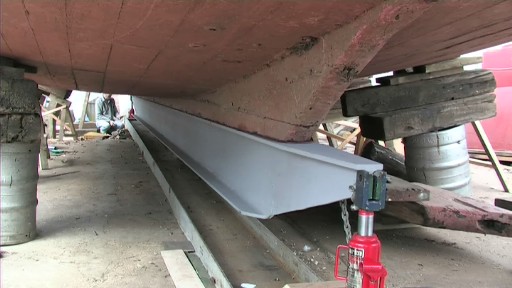
The keel was temporarily jacked into position to allow the new keel bolts to be aligned with the fixing points inside the hull and the corresponding points on the keel. 

Keel bolts aligned
Nuts were welded to the upper surface of the metal keel and the keel bolts were turned into them with mole grips.   Everything was now aligned and ready for the keel to be raised and secured to the hull.

Nuts welded to the new keel.
A liberal application of Sikaflex marine sealant was applied to the keel's upper surface to form a watertight seal.  Finally the new keel was jacked into position and bolted down inside the hull.
Job done!

Job done!