Showing posts with label Wherry-yachts. Show all posts

Wednesday, 1 May 2013

Steel Keel For A Wherry.


At the WYCCT yard at Wroxham on March 5th 2013 "White Moth" was hauled onto the slipway to have her wooden keel replaced with one of steel.  The wherry yacht "White Moth" was built by Ernest Collins in 1915.  King George V ruled Britain and the commonwealth and Henry Asquith was Prime minister.  Since then, to the best of my knowledge, "White Moth's" wooden keel has survived three monarchs, twenty seven Premierships and two World wars. 

When I was first told "White Moth" was having her wooden keel replaced with steel I thought it would make some interesting film footage - I never realised just how interesting this rare piece of engineering would be.  Having spent thirty years in the aviation industry I am no stranger to the many problems that can present themselves during heavy maintenance.  Remarkably this tricky project worked like clockwork from start to finish as each stage was meticulously planned and executed.

"White Moth's" keel clear of the slipway
The first step was to carefully raise and support "White Moth" clear of the slipway.
Then the old keel was surveyed and measured to ensure the steel replacement would retain the same amount of draught.  The old keel bolts were located and exposed by chiseling away sections of keel allowing the bolts to be cut through.

Profiles were fitted to the thirty two feet, or so, of keel on both port and starboard surfaces.  Then using the profiles as a pattern, shallow rebates were sawn along the entire length of the old keel with an electric saw, forming a guide for the serious surgery that was about to follow. 

The keel undergoing serious surgery

A two - man saw of an undetermined vintage was brought into the daylight for, what I imagine was,  the first time for many moons.  It was akin to the type of saws that were once used in saw pits.   Starting at the stern, the two-man saw began slicing its way efficiently through "White Moth's" ancient wooden keel.   The relentless effort needed to drive the saw through six inches of close grained Pitch Pine was nothing short of hard labour.  In spite of the frequent breaks required in the interests of rest and recuperation the keel was cut through surprisingly quickly.

One half of the two man saw in action

After cutting through the keel only a combination of clamps and wedges held it in place. As the clamps were slackened off  the wooden keel was dropped neatly alongside the slipway track, precisely where  intended.  It was difficult to estimate the exact weight of the old keel, but thirty odd feet of Pitch Pine in free fall could not underestimated.  With this in mind great care was taken to ensure that when the keel fell it did not disturb any of the props supporting "White Moth".  The plan worked perfectly. 

Wooden keel removed
While the old keel was being removed it's metal replacement was being fabricated in the "wet shed".  From there it was suspended by an ingenious arrangement of block and tackle and conveyed over the water.  Finely balanced and resting uneasily on a dinghy the new keel was eventually aligned with the slipway where it was submerged onto the slipway track.  

New keel crossing the water
Accompanied by the familiar sound of the ratchet rattling over the cogs on the winch "White Moth's"  new keel, shark-like in appearance, emerged from the water.  Gradually it was winched up the slipway into position beneath the Wherry yacht.

The new keel was winched up the slipway

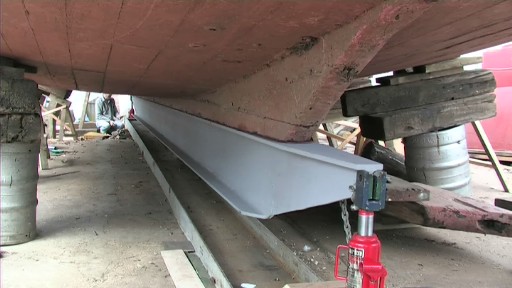
The keel was temporarily jacked into position to allow the new keel bolts to be aligned with the fixing points inside the hull and the corresponding points on the keel. 

Keel bolts aligned
Nuts were welded to the upper surface of the metal keel and the keel bolts were turned into them with mole grips.   Everything was now aligned and ready for the keel to be raised and secured to the hull.

Nuts welded to the new keel.
A liberal application of Sikaflex marine sealant was applied to the keel's upper surface to form a watertight seal.  Finally the new keel was jacked into position and bolted down inside the hull.
Job done!
Job done!


Sunday, 17 March 2013

Wherries and Waterways in Winter.

Winter arrived quite late in East Anglia this year and once established it has seemed very reluctant to leave.  The winter sun which can add a real sparkle to film at this time of year has remained hidden behind layers of oppressive grey cloud.   In spite of the poor conditions it has been possible to shoot some film on the better days.

Some of the most interesting footage this winter has been the progress the of the wherry yacht "Olive" being overhauled at Wroxham.   "Olive" was built by Earnest Collins in 1909 and named after his youngest daughter.  She began working as a holiday cruiser for Blakes the same year and continued working until 1958 when she was sold into private ownership.   Now in the care of of the Wherry Yacht Charter Trust  "Olive" was re-floated in February this year looking very spruce as her freshly painted hull slipped into the water.  Such a dramatic change compared to the tired looking craft that had been winched onto the slipway in July last year.  

Re-floating "Olive"

A few days later it was the turn of "Olive's" sister ship, "White Moth", to be winched onto the vacant slipway.  With the exception of the giant airbags I imagine the operation was not so very different from the traditional methods used long ago in the boatyards.  Watching this grand old vessel inching her way up the track  was a fascinating sight.   

Coltishall Boatyard c1900

Hundreds of man-hours are worked on these essentially Norfolk craft through the winter months.
Fingers numbed with cold and breath vapourising in the frosty morning air are just part of the job.


Another of my regular haunts is the North Walsham and Dilham canal. Spectacular progress on the canal has been maintained over the last twelve months.   Work has been concentrated on the dried out section around Bacton Wood and Royston bridge when the weather has permitted.   The very wet December and the January snow has slowed down the determined work parties but not stopped them altogether.

Winter on The North Walsham and Dilham
We have recorded several hours of video on the canal this winter.  The latest footage will soon be added to the series of DVD's which are now available from the NW&D Canal Trust. http://eawa.co.uk/work.html
Details also available from http://bigskyuk.weebly.com/coming-soon.html 


Winter on the canal can be an in-hospitable place when a stiff  North Easterly is blowing across the open Norfolk landscape.  My fingers have turned blue many times this winter operating the camera and my thoughts have often turned to the wherrymen who sailed these waterways in winter.  Imagine slipping the keel in mid January - Hands in ice-cold water removing stubborn bolts. 
Hard as nails!

Tuesday, 4 September 2012

A Busy Ol' Summer

"Combines" drone across the East Anglian prairies as the long summer days diminish by degrees.  At sunrise Broadland is shrouded in morning mist and at sunset a chill pervades the evening air.   All these signs tell me   summer is rapidly coming to its end. 
 For me this time of year is always tempered with the slightest tinge of melancholy as the Swallows leave our shores and summer slowly fades away.    Very soon the rolling acres of golden stubble will be turned to brown by the plough and the entire county will melt from green and gold into an array of reds and browns.

Golden Stubble.

Looking back, summer has not been so bad in spite of the weather and quite productive even though good shooting days were few and far between.

By the beginning of  May we had finished a two part DVD set for the Aylsham Navigation centenary.  "A Wherry For Aylsham" and "The Aylsham Navigation".   The DVDs are currently on sale and raising urgently needed  funds for the fledgeling BNCT.  

On the North Walsham and Dilham canal work has been progressing at an astonishing pace.   The lock at Spa Common has been completely renovated and the lock gates have been built from scratch.  Both these items have been fascinating to watch and have produced some priceless archive footage.
Completed Lock at Spa Common
 At Ebridge the canal has been returned to its former glory and is teeming with wildlife.   I have never seen so many froglets at one time in my entire life.  The little critters were crawling over each other in their hundreds in the sheltered waters of the mill pool. This abundance of frogs will create a vital link in the food chain  - not the best news for frogs but it will please the Herons .   A Yellow Wagtail made himself at home on the dredger and a Kingfisher showed a great deal of interest as he sped up and down the renovated waterway, in a flash of iridescent blue.   It was at Ebridge that a (four spotted chaser) dragonfly kept me engrossed for almost two hours as it repeatedly skimmed the water and landed a few feet from the camera lens.  More great shots for the archive.

Further downstream  Briggate Mill and Honing lock are looking spruce and well cared for.   In fact the entire length of canal between Honing lock and Royston bridge has seen unbelievable progress which has been diligently recorded and safely stored.

A few miles away at WYCCT yard the wherry yacht "Olive" is undergoing some major surgery on the slipway.  My weekly visits have produced some interesting archive material.   Sister ship "Norada" was re-launched earlier this summer in time for her centenary year. Although the weather did it's best to spoil the day there was a gathering of wherries on Salhouse broad to welcome her back.
"Norada" On The Slipway

One of the highlights of the summer was the shoot on Wroxham broad,  I was invited as a guest of the Norfolk Wherry Trust.  The event was a celebration of the last Norfolk wherry to be built.  The wherry in question was the "Ella" now long gone - but not forgotten  -  sunk in Decoy broad some years ago when she reached the end of her useful life. Her skipper on that last journey, (Mr John Bircham) was among the guests. Five of the eight surviving wherries sailed into Wroxham broad in honour of "Ella"   Making a fantastic sight as they sailed in a loose formation around the broad.  It was a great filming opportunity which allowed me to capture some of my best wherry footage to date.
"Albion" Shooting Wroxham Bridge (Photo courtesey Chris Holloway)

Another highlight this summer was filming "Albion" passing under Wroxham bridge on her way to and from Coltishall where she was one of the star attractions of the BNCT centenary event.   In order to shoot the bridge it was necessary to flood the bilges to gain those precious inches of air draught that would allow her through.


 I am looking forward to Autumn and the softer light that comes with it and those sumptuous Autumn colours. 

If you would like to view clips of  the projects mentioned above click on the link below.

http://www.youtube.com/user/norriemk2?feature=mhee


Monday, 28 May 2012

"Norada"

Recently I spent the day with the Wherry Yacht Charter Charitable Trust in Wroxham.  I went there to film "Norada" being hauled onto the new slipway for some dry dock maintenance before she goes out on charter. The equipment to winch "Norada" onto the new slipway had been tested and trialed but this was the the first time it had been used for real.     The wherry yacht was winched out of the water just far enough to attach the A-frame and the air jacks.  Then slowly but surely "Norada" was inched majestically up the slipway - fascinating!

I have a limited knowledge of boats and their design so it was curiosity that drove me to research "Norada's" pedigree.

There is a theory that the elegant lines of the old trading wherries can be traced back to the Viking long ships.  True or not, there is no doubt that the graceful profile of a trading wherry is very pleasing to the eye.    When freight shifted from the river to the railway many trading wherries were converted to pleasure wherries.  Then, as tourism on the broads grew in popularity, purpose built pleasure wherries were turned out of the yards to meet the growing demand.   The ultimate development of the pleasure wherries led to the  emergence of the lighter and faster Wherry yachts.   "Luxury afloat" was unashamedly built into these hire craft and the Edwardians loved them.    

"Norada" is one of three wherry yachts currently operated by the WYCCT,  her sisters are "Olive" and "White Moth".   All three of these vessels were built by Ernest Collins of Wroxham.    The origin of these elegant craft is a fascinating story in its own right.

Wherry Yacht "White Moth"
(photograph courtesy of Katy Walters )

In late summer 1903, the beach yawl "New Skylark" was carrying thirteen passengers on a pleasure trip from the beach at Great Yarmouth.   About a mile out she collided with the F E Webb, a steamer out of London.  The "New Skylark" was practically cut in half and sank instantly with the loss of six souls.

Almost a week after the accident the wreckage of the "New Skylark" was recovered and towed into Yarmouth harbour.  Ernest Collins learned of the "New Skylark" and bought the wreck.   He redesigned her with cabin accommodation for ten adults and added a counter stern.  With a gaff and boom rig she was  re-launched as the wherry yacht  “White Heather”.   "White Heather" could be hired for around ten pounds per week including a skipper and an attendant, she continued working as a hire craft until 1932.

In 1909 Ernest Collins built "Olive" a dedicated wherry yacht naming the vessel after his youngest daughter.  The interior layout used in "White Heather" had been so successful it was replicated in "Olive".    "Olive" weighed in at twenty one tons with a draught of three feet six inches.   She could only squeeze under Potter Heigham bridge if tidal conditions were perfect, and passing under the old Ludham bridge was out of the question.

Next came "Norada" she was named after the nineteen metre class, racing yacht of the same era.  "Norada"  was launched in 1912, the same year as "Titanic".  However the the wherry yacht proved to be infinitely more durable than the ill fated liner.    "Norada" weighing just sixteen tons was shorter than "Olive" by three feet, and twenty one inches narrower in the beam.   She was designed specifically to pass under the "Old" Ludham bridge by virtue of a lower cabin than her sister "Olive"   "Norada's" reduced dimensions would also allow her to sail freely and unhindered through the locks on the Upper Bure and the Ant.  Ironically many of the locks and bridges were washed away in the great flood the same year she was launched. 


Racing Yachts circa 1900.
 
 "Norada" continued working as a hire craft until 1950 when necessary economies to the Collins hire fleet led to her being sold into private ownership, her new owner renamed her "Lady Edith".   Then in 1964 Barney Matthews, once a skipper for Ernest Collins, bought and restored the wherry yacht.  In her seventy-fifth year she was once again named  "Norada". 

2012 is "Norada's" centenary year - watch out for this spirit of the Edwardian age sailing on the Norfolk and Suffolk waterways this summer.  


If you would like to see a short video of "Norada" being "hauled out" click here.