Wednesday, 1 May 2013

Steel Keel For A Wherry.


At the WYCCT yard at Wroxham on March 5th 2013 "White Moth" was hauled onto the slipway to have her wooden keel replaced with one of steel.  The wherry yacht "White Moth" was built by Ernest Collins in 1915.  King George V ruled Britain and the commonwealth and Henry Asquith was Prime minister.  Since then, to the best of my knowledge, "White Moth's" wooden keel has survived three monarchs, twenty seven Premierships and two World wars. 

When I was first told "White Moth" was having her wooden keel replaced with steel I thought it would make some interesting film footage - I never realised just how interesting this rare piece of engineering would be.  Having spent thirty years in the aviation industry I am no stranger to the many problems that can present themselves during heavy maintenance.  Remarkably this tricky project worked like clockwork from start to finish as each stage was meticulously planned and executed.

"White Moth's" keel clear of the slipway
The first step was to carefully raise and support "White Moth" clear of the slipway.
Then the old keel was surveyed and measured to ensure the steel replacement would retain the same amount of draught.  The old keel bolts were located and exposed by chiseling away sections of keel allowing the bolts to be cut through.

Profiles were fitted to the thirty two feet, or so, of keel on both port and starboard surfaces.  Then using the profiles as a pattern, shallow rebates were sawn along the entire length of the old keel with an electric saw, forming a guide for the serious surgery that was about to follow. 

The keel undergoing serious surgery

A two - man saw of an undetermined vintage was brought into the daylight for, what I imagine was,  the first time for many moons.  It was akin to the type of saws that were once used in saw pits.   Starting at the stern, the two-man saw began slicing its way efficiently through "White Moth's" ancient wooden keel.   The relentless effort needed to drive the saw through six inches of close grained Pitch Pine was nothing short of hard labour.  In spite of the frequent breaks required in the interests of rest and recuperation the keel was cut through surprisingly quickly.

One half of the two man saw in action

After cutting through the keel only a combination of clamps and wedges held it in place. As the clamps were slackened off  the wooden keel was dropped neatly alongside the slipway track, precisely where  intended.  It was difficult to estimate the exact weight of the old keel, but thirty odd feet of Pitch Pine in free fall could not underestimated.  With this in mind great care was taken to ensure that when the keel fell it did not disturb any of the props supporting "White Moth".  The plan worked perfectly. 

Wooden keel removed
While the old keel was being removed it's metal replacement was being fabricated in the "wet shed".  From there it was suspended by an ingenious arrangement of block and tackle and conveyed over the water.  Finely balanced and resting uneasily on a dinghy the new keel was eventually aligned with the slipway where it was submerged onto the slipway track.  

New keel crossing the water
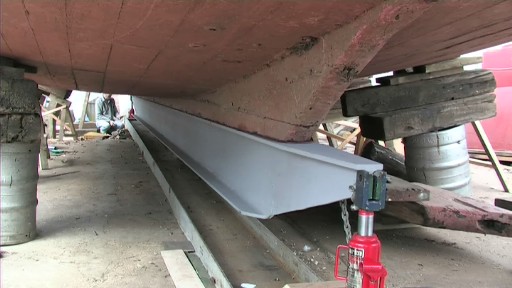
Accompanied by the familiar sound of the ratchet rattling over the cogs on the winch "White Moth's"  new keel, shark-like in appearance, emerged from the water.  Gradually it was winched up the slipway into position beneath the Wherry yacht.

The new keel was winched up the slipway

The keel was temporarily jacked into position to allow the new keel bolts to be aligned with the fixing points inside the hull and the corresponding points on the keel. 

Keel bolts aligned
Nuts were welded to the upper surface of the metal keel and the keel bolts were turned into them with mole grips.   Everything was now aligned and ready for the keel to be raised and secured to the hull.

Nuts welded to the new keel.
A liberal application of Sikaflex marine sealant was applied to the keel's upper surface to form a watertight seal.  Finally the new keel was jacked into position and bolted down inside the hull.
Job done!
Job done!


Sunday, 17 March 2013

Wherries and Waterways in Winter.

Winter arrived quite late in East Anglia this year and once established it has seemed very reluctant to leave.  The winter sun which can add a real sparkle to film at this time of year has remained hidden behind layers of oppressive grey cloud.   In spite of the poor conditions it has been possible to shoot some film on the better days.

Some of the most interesting footage this winter has been the progress the of the wherry yacht "Olive" being overhauled at Wroxham.   "Olive" was built by Earnest Collins in 1909 and named after his youngest daughter.  She began working as a holiday cruiser for Blakes the same year and continued working until 1958 when she was sold into private ownership.   Now in the care of of the Wherry Yacht Charter Trust  "Olive" was re-floated in February this year looking very spruce as her freshly painted hull slipped into the water.  Such a dramatic change compared to the tired looking craft that had been winched onto the slipway in July last year.  

Re-floating "Olive"

A few days later it was the turn of "Olive's" sister ship, "White Moth", to be winched onto the vacant slipway.  With the exception of the giant airbags I imagine the operation was not so very different from the traditional methods used long ago in the boatyards.  Watching this grand old vessel inching her way up the track  was a fascinating sight.   

Coltishall Boatyard c1900

Hundreds of man-hours are worked on these essentially Norfolk craft through the winter months.
Fingers numbed with cold and breath vapourising in the frosty morning air are just part of the job.


Another of my regular haunts is the North Walsham and Dilham canal. Spectacular progress on the canal has been maintained over the last twelve months.   Work has been concentrated on the dried out section around Bacton Wood and Royston bridge when the weather has permitted.   The very wet December and the January snow has slowed down the determined work parties but not stopped them altogether.

Winter on The North Walsham and Dilham
We have recorded several hours of video on the canal this winter.  The latest footage will soon be added to the series of DVD's which are now available from the NW&D Canal Trust. http://eawa.co.uk/work.html
Details also available from http://bigskyuk.weebly.com/coming-soon.html 


Winter on the canal can be an in-hospitable place when a stiff  North Easterly is blowing across the open Norfolk landscape.  My fingers have turned blue many times this winter operating the camera and my thoughts have often turned to the wherrymen who sailed these waterways in winter.  Imagine slipping the keel in mid January - Hands in ice-cold water removing stubborn bolts. 
Hard as nails!

Monday, 11 February 2013

When You And I Were Young.

The winter months with the cold days and poor light has restricted filming this year.   However it is a good time to research and review the projects in hand.  To do this I have been reading a lot of local history books which has highlighted many of the changes that earlier generations had to cope with.  It seems the rate of change was much slower for our ancestors until the mid nineteenth century when Britain changed from an agricultural economy into an industrial power. 


Of late, I have become acutely aware of how quickly things have changed in my life time mainly due to advances in technology.
Growing up in the austerity of "post war" Britain was character building to say the least.  For us kids, a "bombed site" was our playground and it was only the better-off kids who didn't have a patch sewn into the seat of their trousers.

Post war bomb site.
 Instead of computer games and iPods we had catapults and tin cans and I can't ever remember school being closed because of bad weather.  In hail, rain or snow we would walk to school, the tops of our Wellington boots chafing red weals on our skinny little legs.  At school, thirty or so nine year olds would heap their wet coats in front of a luke warm radiator and pretend they would be dry by "home time".
After school mum would often send one of us to the corner shop to get a shilling for two sixpences to feed the electricity meter.  Heroically we would plead with the grumpy shopkeeper who would not let us have the shilling unless we were buying something.  Sometimes it was necessary to try two or three shops in order to get the shilling that would restore power to the house and save Father's evening meal by the time he got home from work.

Our family's first black and white TV set had a nine inch screen that flickered continually - just one channel to watch and that closed down for an hour in the early evening.  Programmes then resumed until about ten pm.  At the end of transmission the tv was turned off and we would sit msmerised until the little white dot had completely disappeared.

Courtesy Paul Townsend CC licence.

The excitement that was generated when the first commercial TV channel opened some years later and wonder of wonders, the arrival of colour television.  

To hear the latest popular music most youngsters listened to Radio Luxembourg which always seemed to fade when the best records were playing.  An alternative was "Two Way Family Favourites" at Sunday lunch time with Jean Metcalf and Cliff Michelmore.  BFPO's - Frankie Lane - Lita Rosa - Anne Shelton such wonderful memories.

At nineteen years old I became the first one in our family to own a car  -  a 1937 Y-Type Ford which cost me twentyseven pounds ten shillings.
An eight horse power engine that would drain the six volt battery on a frosty morning in no time at all.  No heater and windscreen wipers that went ever slower as the car went faster.  Screen washers did not exist. To clean the windscreen an old bottle of washing up liquid filled with water was held out of the drivers window and squirted onto the screen - most of which was propelled back up the drivers arm by the slipstream.      Before the days of filling stations we went to the the local garage for our petrol,  At the garage a man would clean the windscreen and and ask how much fuel you required.  He would then pump in the usual two gallons (approx nine litres) of National Benzole which cost seven shillings (thirty five pence).

1937 Y-type Ford (Courtesy Charles 01 CC licence)

Around this time I became a bus conductor.  Every bus had a driver at the front and a conductor at the back.   There was a bus every six minutes on most city routes.
On Saturday nights we would queue round the block for the cinema, the cheapest seats cost one and ninepence (eight pence). The uniformed commissionaire would call out when seats became available. There were no defined performances just a continuous programme running all day until it ended with the national anthem at about ten fifteen in the evening. The smart folk would make for the exits before the National anthem was played and before everyone in the theatre stopped and stood to attention, otherwise you would miss the last bus home.

Queuing round the block for the cinema.

Health and safety tended to be left to God and providence, staying sharp was essential.
This was true of my time spent in a coal yard - the loaded railway trucks were free-wheeled down an incline into the yard where we would shovel the coal by the hundredweight into sacks and load them onto lorries.    The railway trucks would be set in motion with a pinch bar and they would run silently down the gradient amid lots of shouting and whistles.  To stop the truck we would push a brake stick onto the brake handle and bounce up an down on it to stop the truck - a lightweight like me would have to do a lot of bouncing to slow the waggon.


Coal Train (Courtesy Ben Brooksbank CC licence)

Soon after this England won the World Cup and computers began to confuse the entire nation.
Our reliable old red telephone boxes were abandoned for mobile phones.  The modern age had arrived - for a little while at least.


Saturday, 15 December 2012

"Albion's" Home Run.

On Saturday, December 8th, I joined a volunteer crew from the Norfolk Wherry Trust to bring "Albion" home from Oulton Broad.  Albion had been at Excelsior's yard on Lake Lothing for winter maintenance. She became stranded at Oulton Broad due to bridge repairs on the Waveney and the Bure.

At 8am, seven volunteers and their equipment were dropped off at Oulton Broad yacht station and the cars departed leaving the crew to make "Albion" ready for her return to base.
The plan was to cross Breydon and reach Great Yarmouth at slack water, and be back at Ludham before dark.

Early morning at Oulton Broad

Every member of the crew knew exactly what was needed and set about their tasks.  Most of them had made this trip several times before.   The frosty morning had covered "Albion's" plank-ways and hatches with a  veneer of ice, making movement around the vessel quite treacherous.
Everyone of the crew were either Skippers or Mates - I was the only "Greenhorn" on board.
My job was to record the journey.  For my part in the proceedings conditions could not have been better.   No wind, crystal clear light and winter sun - absolutely perfect.

"Albion's" mast had been removed for overhaul some weeks earlier, so "Badger", a motor cruiser, was tied alongside to power the wherry on the return journey.

Making ready.

 "Badger" and "Albion" had an overall beam of twenty six feet, with "Badger" providing the power and "Albion" providing the steerage.  Additional power, if required, could be supplied from "Albion's" tender hitched to the stern of the wherry.  After about forty minutes preparation our little flotilla cast off.

The tender was quickly pressed into service nudging "Albion's" bow through forty five degrees until she came about and headed toward Oulton Dyke.


Great shots from the tender

I was able to get some some great shots from the tender as it manoeuvred around the wherry.  Then we were back on board and heading up the Waveney toward Great Yarmouth.

This was the first time I had travelled on this stretch of water so everything around me was very fresh and new.  From a photography point of view, if I did this trip one hundred times, the light and conditions would never be as good as this again.

River as calm as a mill pond

Ahead of us the river was as calm as a mill pond, golden coloured reeds reflected in the still water as we glided by - absolutely priceless!    Astern of us the wake from "Badger" glistened in the early morning sun.


Through St Olaves bridge and past Burgh Castle, "Badger's" engine never faltered, we were bang on schedule to reach the Breydon bridge at slack water.

St Olaves


There was a burst of activity on the plank-way as chains and mudweights were deployed, in case they were needed.


Chains and mudweights.

 Across the desolate, but strangely beautiful mudflats of Breydon.  Experienced eyes noted the tide was slowing by watching the current flowing around the navigation posts.   Under Breydon bridge at 12.10 - perfect timing.

Breydon - desolate and beautiful.

  Next, the old Vauxhall railway bridge, we were on time, on the Bure and on our way home.
 "Badger's" engine note changed tune as the "wick was turned up".  Behind our flotilla the wake was decidedly more agitated as our speed increased. Home before dark was the plan.   The sun was following an ever lowering arc creating longer shadows but still perfect for filming.


Albion at Acle bridge.

The cold air was beginning to nip fingertips by Stokesby and one last foray in the tender captured great footage of "Albion" shooting Acle bridge.  A setting sun made the water sparkle and "Albion's" crew became silhouettes against an evening sky of burnished gold and blue.


The crew became silhouettes

Into the Thurne and faithful old "Badger" was cast off and literally drifted off into the sunset.  The tender's outboard powered "Albion" on the last leg of the journey along the narrow channel of Womack water.  Six and half hours after leaving Oulton Broad "Albion" was home.


"Badger" drifted off into the sunset

For the folk who regularly sail the Norfolk and Suffolk waterways I guess this journey would be nothing out of the ordinary.  But for this "Geenhorn" sailor it is a trip I shall always remember.
 

Thursday, 22 November 2012

The Last Norfolk Coypu.


The rain is driving across the Norfolk marshes on the leading edge of a strong "North Easterly", signalling the arrival of winter.   These cold wet days mean Filming opportunities become few and far between.   While we wait for the brittle light that comes with the winter sun we decide to empty our loft of items that have been stored there and forgotten.  We sift through the treasures that once seemed so valuable and important to us  - it is strange how they have gradually transformed themselves from treasure into junk in the darkness of the loft. 

Among the growing piles of “Tip” or “Charity shop” I find a little book that belonged to my father.  “As I was a-sayin” by Jonathan Mardle. (Mardle is Norfolk for gossip) 
Jonathan Mardle was the pen name of Eric Fowler a journalist on the local newspaper, the “Eastern Daily Press” (known locally as The Norfolk News), he wrote about all things Norfolk.   The little book was printed in 1950, marked seven and sixpence, and is a collection of Eric Fowler’s articles describing his travels around post war Norfolk.  He paints fascinating word pictures about the Broads of a time when they were vastly different than they are today.

Two articles were of particular interest to me – the first, his trip on the freshly restored “Albion” in January, 1950, carrying cargo for the newly formed  Norfolk Wherry Trust.   Laden with forty tons of sand, gravel and cement out of Norwich, bound for Berney Arms and crewed by Jack Cates and his Brother George.

The second article that took my eye was his visit to “Wheatfen”, home of Norfolk naturalist (the late) Edward (Ted) Ellis.  He describes a colony of Coypu living in the sanctuary of “Wheatfen” safe from the trappers.  Every Coypu had a price on its head, or to be more precise, a price on its tail.   “Ted” Ellis considered the Coypu gentle creatures that lived off waterside vegetation, and he believed that Coypu actually helped to keep the channels clear.  I suspect Ted had never harmed a living creature in his entire life, based on the times I have met and spoken with him.
Coypu or Nutria (Photo courtesy of Alpsdak)
 The Coypu had few allies and in the end it was the trappers who prevailed and by 1989 the Coypu had been eradicated from Norfolk’s waterways.   The rise and fall of Norfolk’s Coypu population is quite a sad story.   Coypu also known as Swamp Beaver or Nutria were imported from South America to the fur farms of Broadland in the 1920’s.  They were bred in captivity for the soft layer of waterproof fur under their coarse outer coat.  Inevitably some of them escaped into the yare valley which suited them perfectly.   Rivers, marshland and fields full of crops were ideal for the Coypu, it is no wonder that they thrived there. 

Norfolk’s waterways were a long way from Chile from where the Coypu originated. They were strange looking animals with large orange incisor teeth poking out of their white muzzles.  Their ears and eyes were set high on their head to allow good vision and hearing while swimming.  The females had nipples high on their flanks to allow them to suckle their young while travelling through the water, propelled by a pair of powerful, webbed hind feet.
Living in the wild they had a span of about three years providing they could stay clear of the trappers.   A female Coypu was sexually mature at about four months and could have up to three litters a year.  Baby Coypu were born with their eyes open and a full coat of fur, they could be feeding on vegetation within a few hours of being born.  The adults consumed one quarter of their body weight every day eating Sedge, Reed, Water Lillies and other waterside plants. 
Photo courtesy of Alpsdak
 In the sixties I was working on a pumping station on Cantley marshes with a gang of Irish contractors.  One of them took his lodging allowance to the local pub and he did not stagger out until he had spent the lot.
As he had no money for his lodgings he slept alone, in the cement shed, on the marsh.
During the night, amidst the popping Marsh gas and the rising mist he saw a rat which he claimed was "bigger than a cat".   Next morning when we turned up for work he asked me if all Norfolk rats were that big – what he had seen was a Coypu.  He left Norfolk at the end of the job believing that our county hosted the largest breed of rats in the civilised world.

Coypu are quite large rodents, adults could weigh up to twenty two pounds and could reach two feet in length with an additional twelve inches of tail.  It was their burrowing activities that brought about  their eventual eradication.  They created networks of tunnels in the river banks which filled with water and became prone to caving in, this increased the risk of flooding.
Coypu are large rodents (Photo courtesy of Schieber)

Nor were the Coypu a friend of the farmers.  When waterside vegetation became less plentiful the Coypu moved into the fields of sugar beet.  They would work along the rows taking a bite or two from each plant leaving a trail of worthless crops in their wake. 
So the death sentence was passed on all Coypu, “five bob a tail” was the bounty and by 1989 trappers had wiped out the Coypu in Norfolk. 
  
Trappers Harvest (Photo courtesy of US Government)

Coming from a tropical climate Coypu were susceptible to frostbite in their tails during the hard winters.  This lead to infection and eventual death, but the demise of the largest numbers of Norfolk Coypu was due to the trappers not natural causes.  The trappers used square, wire cage traps to catch the Coypu, then cut off the animal’s tail to collect the bounty.


I would like to believe that somewhere in the more remote parts of Broadland there just might be a small group of fugitive Coypu hiding out, living up to their outlaw status.

French Coypu  (Photo courtesy Tangopaso)


Authors footnote
1. Coypu are quite common in Europe and America

2. "As I Was A-sayin" by Jonathan Mardle is still available but no longer at 7/6d.


Wednesday, 7 November 2012

The End Of Briggate Mill.

The remains of the old mill at Briggate have now faded into history and another small chunk of Norfolk heritage has been lost.  A variety of plans to convert and use the mill were put forward over the years but sadly none of them came to fruition and no reprieve for Briggate mill was forthcoming.   On October 30th this year the granary was demolished.

The End For Briggate Mill
Corn was first ground at Briggate mill in 1793, the early mill was powered by a breast shot water wheel (the wheel was removed in 1943). 
In it's two-hundred year history the mill was modified and altered many times, the original granary was destroyed by fire in 1890 and was replaced by the building which was recently demolished.  In the same year steam became the motive power which was eventually superseded by electricity.
Production ceased in 1969 and the mill changed hands a few times until it was purchased for redevelopment in 1975.   Six months after the purchase Briggate mill was destroyed by a suspicious fire.

As recently as 1983 it was proposed to redevelop the mill to generate electricity and produce paper.  But the project never got beyond the planning stage. 

Since the new millennium the mill site has survived an an attempted "land grab" and it has also been rejected as the site for a village green.   Conversion to a village green would have been a fitting memorial for the old mill instead of simply reducing it to rubble.

Falling Masonry
An early morning phone call on the 30th of October (2012) tipped me off that the old granary was being demolished.  This was confirmed on the local radio station by sounds of falling masonry.   My toast was abandoned in the toaster and a mug of tea was left steaming on the kitchen table.  Cameras and equipment were loaded in a matter of minutes and I was on my way to Briggate.  Since following the activities of the North Walsham and Dilham Canal Trust, Briggate mill has formed an imposing  backdrop to that section of the canal.  To watch it being slowly erased from the landscape in the morning mist was quite a sad spectacle.  The entire sorry episode was captured on film.

The End Of The Granary
These type of events need to be viewed with perspective - and to do this it is necessary to remove the "rose tinted" spectacles.  The granary building had become, without doubt, an unsafe structure and needed some urgent attention.  The granary was, in fact, only built in 1890 after the original granary was burned down.  A mere one-hundred-and-twenty years, which is not a great age for a building.  It was, however, a link to the ruins of the original mill, parts of which still survive - for the moment.

To learn more about the very colourful and intriguing history of Briggate mill visit the excellent "Norfolk Mills" site. http://www.norfolkmills.co.uk/Watermills/briggate.html


Wednesday, 3 October 2012

Broadland Myths and Legends.

"Mist On The Marsh" is now well into it's third year in production - I originally thought it would take me about two years to complete.   There have been times when I have wondered if the film would ever be finished and periodically questioned my sanity for even starting it.

Thankfully persistence has paid off and the documentary parts of the film have been completed at long last.  We started filming the Myth and Legend sequences a few weeks ago.   A group of actors and actresses have enthusiastically bought into the project and breathed new life  into what was becoming a tired production.

We are currently shooting the legend of Christopher Burraway who is buried in St Mary the Virgin parish church at Martham.
The curious "Burraway inscription" has been the subject of conjecture for many years.

Martham Church
  "Here lyeth the body of Christopher Burraway, who departed this life ye 18th day of October, anno domini 1730 aged 59 years.
And there lies Alice, who by her life  was my sister, my mistress, my mother and my wife.  Dyed Feb ye 12, 1729, aged 76 years."


The legend claims that a child was conceived by a father and his daughter.  To avoid the scandal the child was quickly dispatched to another county, where he was given the name Christopher, and fostered until he "came of age".  He took to the road and earned his keep by taking farm work where ever he could find it.   Purely by chance he returned to Norfolk - looking for work.   Knowing nothing of his past or parentage it seems that fate drew him to Martham where he was offered work by a lady farmer named Alice.   Christopher was so diligent in his work that Alice made him bailiff and gradually Christopher  struck up a close friendship with his employer.  Although he was almost twenty years younger than Alice they eventually married.

Shortly after the wedding they were preparing for bed when Alice noticed a strange birthmark on Christopher's shoulder.  It was identical to the birthmark on the child she had abandoned all those years earlier, and yes, you've guessed it - she had married her own son.

Alice and Christopher in a scene from "Mist On The Marsh"
 This sorry tale raises far more questions than answers and there is more than one rational explanation for the "Burraway inscription".  Personally I prefer the folklore version because it makes the film much more interesting.

Martham is well worth a visit - if you are going by boat it means passing under the notorious bridge at Potter Heigham which guarantees a bit of excitement.  If you can make it under the bridge travel up the Thurne.  The stone bearing the inscription can be seen in the south aisle of the church.  If you do decide to visit Martham don't  go just to see the "Burraway" stone.  St Mary's is a beautiful church with many outstanding features.  It also has the alternative version of the "Burraway inscription" in the church guide.

Gargoyle On Martham Church

What's next - "Black Shuck" - now that is a legend.